Skip to content
Email Get a Quote: [email protected]
qilu-toolsteel.com
  • Home
  • About us
  • ProductsExpand
    • Cold work tool steel
    • Hot work tool steel
    • High Speed Tool Steel
    • Plastic Mould Steel
  • IndustrysExpand
    • Automotive Industry
    • Construction Industry
    • Aerospace Industry
    • Medical Industry
    • Energy Industry
    • Military Industry
    • Mechanical industry
  • Service Center
  • Blog
  • Contact Us
Email [email protected]
qilu-toolsteel.com

Tool steel knowledge sharing

Hello, welcome to our tool steel knowledge sharing platform. We will regularly share various knowledge points in the field of tool steel. Our purpose is to spread this knowledge to help more technicians and companies engaged in the tool field understand industry trends and choose correct and high-quality tool materials.

Call To Action
  • A11 tool steel

    A11 vs D2 Steel: Why Your Industrial Knives Keep Failing & How to Stop It

    If your slitting blades lose their edge every shift while cutting abrasive fiber, non-wovens, or high-density paper, you’re likely stuck in the “D2 trap.” D2 tool steel is a standard,…

    Read More A11 vs D2 Steel: Why Your Industrial Knives Keep Failing & How to Stop ItContinue

  • 904L stainless steel vs 316L in aggressive chemical service

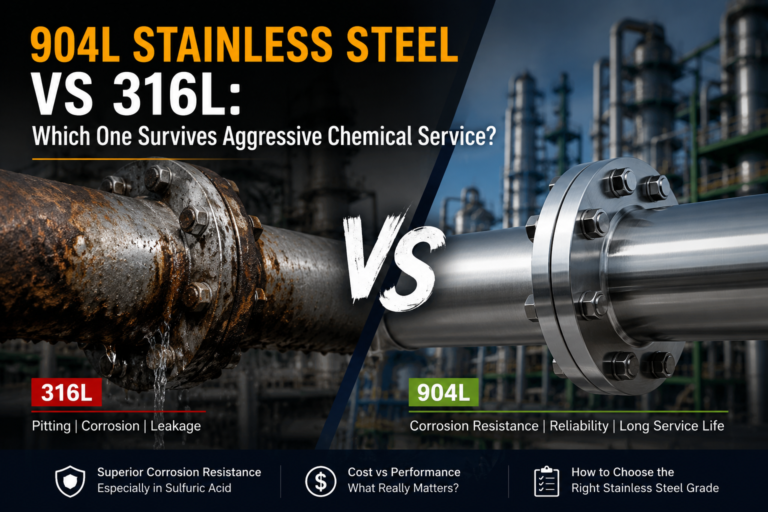
    904L Stainless Steel vs 316L: Which One Survives Aggressive Chemical Service?

    904L stainless steel vs 316L is usually treated like a material upgrade question, but for chemical and pharmaceutical equipment buyers, the real issue is simpler: which grade is less likely…

    Read More 904L Stainless Steel vs 316L: Which One Survives Aggressive Chemical Service?Continue

  • 1.2379 vs D2 steel comparison with material certificates for European mold projects

    1.2379 vs D2 Steel: Can D2 Replace 1.2379 in European Mold Projects?

    1.2379 vs D2 steel is not only a hardness comparison. For European mold export projects, the real question is whether the material can pass the drawing, standard system, MTC, heat…

    Read More 1.2379 vs D2 Steel: Can D2 Replace 1.2379 in European Mold Projects?Continue

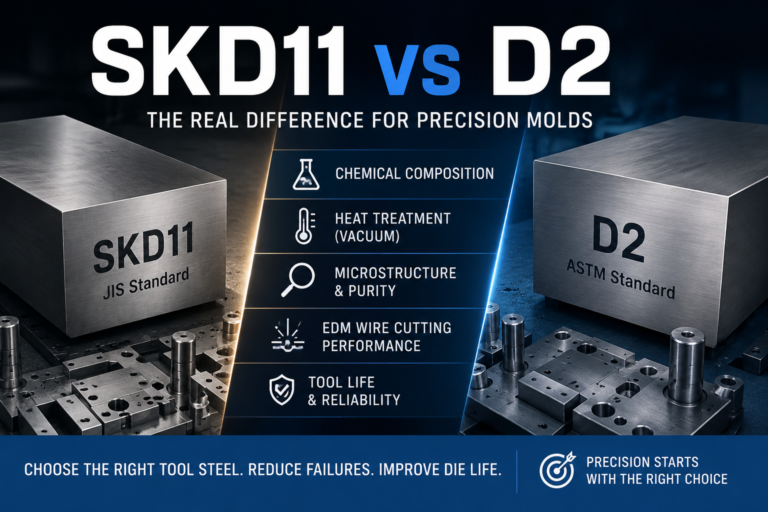
  • SKD11 vs D2 tool steel comparison for precision molds, vacuum heat treatment, EDM wire cutting, impurity control, and edge stability

    SKD11 vs D2 Steel: Are They the Same After Vacuum Heat Treatment?

    SKD11 vs D2 is not a simple “same or different” question. For general tooling, they are often treated as close equivalent tool steel grades. For precision dies, fine punches, EDM…

    Read More SKD11 vs D2 Steel: Are They the Same After Vacuum Heat Treatment?Continue

  • SKD61 vs H13 tool steel comparison with engineering drawing, material certificate, heat treatment furnace, and mold components

    SKD61 vs H13: Can H13 Replace SKD61 on Japanese Drawings?

    SKD61 vs H13 is a real sourcing question, not just a steel-grade comparison. When a Japanese drawing specifies SKD61, many factories ask whether AISI H13 can be accepted as an…

    Read More SKD61 vs H13: Can H13 Replace SKD61 on Japanese Drawings?Continue

  • D6 vs D2 steel comparison cover showing cold work tool steel blocks, carbide structure, dies, punches, shear blades, and precision tooling applications

    D6 vs D2 Steel: Which Cold Work Tool Steel Fits Your Die Application?

    D6 vs D2 steel should be chosen by failure mode, not hardness alone. If a die mainly wears from abrasion, D6 may help. If the tool also sees chipping, impact,…

    Read More D6 vs D2 Steel: Which Cold Work Tool Steel Fits Your Die Application?Continue

  • Industrial workshop scene showing D2 and D3 tool steel with blanking die, grinding wheel mold, slitting cutter, wear plate, and abrasive forming die, illustrating extreme wear applications.

    d2 vs d3 tool steel: Which One Lasts Longer in Extreme Wear?

    D2 vs D3 tool steel matters when a die, cutter, mold, or wear plate fails by slow abrasive damage instead of one sudden overload. The real cost is not just…

    Read More d2 vs d3 tool steel: Which One Lasts Longer in Extreme Wear?Continue

  • O1 vs A2 tool steel comparison for precision tools and heat treatment stability

    O1 vs A2 Tool Steel: Which Holds Size Better After Heat Treatment?

    When producing small, high-precision tools, understanding O1 vs A2 tool steel is crucial. Manufacturers often face unexpected size changes after heat treatment, leading to costly rework or scrap. The challenge…

    Read More O1 vs A2 Tool Steel: Which Holds Size Better After Heat Treatment?Continue

Page navigation

1 2 3 … 52 Next PageNext

Recent Posts

  • A11 vs D2 Steel: Why Your Industrial Knives Keep Failing & How to Stop It
  • 904L Stainless Steel vs 316L: Which One Survives Aggressive Chemical Service?
  • 1.2379 vs D2 Steel: Can D2 Replace 1.2379 in European Mold Projects?
  • SKD11 vs D2 Steel: Are They the Same After Vacuum Heat Treatment?
  • SKD61 vs H13: Can H13 Replace SKD61 on Japanese Drawings?

Categories

  • tool steel
  • Uncategorized

Quick Links

  • About
  • Products
  • Quality Control
  • Contact
  • Privacy Policy
  • Refund Policy

30+years steel industry experience, providing professional service with qualified steel products.

GET A QUOTE: [email protected]

Qilu Steel is a leading supplier of high-quality tool steel with extensive experience in the industry. Our investment in a specialized factory further demonstrates our commitment to being at the forefront of the tool steel industry. We offer a wide range of tool steel grades, including P20, H13, D2, and S7, each with unique properties suited for different applications.

Quick Links

  • About
  • Products
  • Quality Control
  • Contact
  • Privacy Policy
  • Refund Policy

Website Group

  • Qilu-Steel
  • Qiluspecialsteel

Explore

  • [email protected]
  • +86-18266768780
  • Office Address Yanzhou building,Economic zone,Yanzhou,Jining,China

Copyright © 2024 Qilu steel

  • Home
  • About us
  • Products
    • Cold work tool steel
    • Hot work tool steel
    • High Speed Tool Steel
    • Plastic Mould Steel
  • Industrys
    • Automotive Industry
    • Construction Industry
    • Aerospace Industry
    • Medical Industry
    • Energy Industry
    • Military Industry
    • Mechanical industry
  • Service Center
  • Blog
  • Contact Us