
904L stainless steel vs 316L is usually treated like a material upgrade question, but for chemical and pharmaceutical equipment buyers, the real issue is simpler: which grade is less likely to turn into a leak, an emergency shutdown, or an expensive replacement.
That is why this comparison matters. 316L is widely used, familiar to fabricators, and usually easier on budget. But once sulfuric acid, chlorides, acidic cleaning cycles, weld zones, and difficult-to-access equipment come into the picture, the cheaper grade can become the more expensive choice.
This guide focuses on what buyers actually need to decide: where 316L is still sensible, where 904L starts to justify itself, and how to think about 904L vs 316L cost vs performance without reducing the decision to raw material price alone.
Why Does 316L Fail Faster in Some Chemical and Pharmaceutical Systems?
316L is not a bad stainless steel. In fact, AZoM’s Grade 316L overview notes that it is the standard molybdenum-bearing austenitic grade and is widely used because it offers better corrosion resistance than 304 in many industrial environments.
The problem is that “better than 304” does not mean “safe in every corrosive service.”
In real plants, 316L often struggles when one or more of these conditions show up together:
- sulfuric acid exposure
- chloride-rich process water
- acidic CIP or cleaning chemicals
- stagnant crevices around gaskets or lap joints
- welded areas with poor post-weld treatment
- elevated temperature
When failure happens, it often does not look dramatic at first. It may start as pitting, staining near welds, crevice attack under deposits, or localized thinning around a joint. But once that attack reaches a vessel wall, pipe, or heat exchanger area, the result is no longer “surface corrosion.” It becomes contamination risk, product loss, unplanned maintenance, and downtime.
That is the first practical takeaway in 904L stainless steel vs 316L: 316L often fails not because it is poor stainless steel, but because it is used beyond the corrosion margin that the service actually requires.
904L Stainless Steel vs 316L: What Really Changes in the Alloy?
A material comparison is only useful if it explains why one grade behaves differently in service.
According to the Wikipedia article on SAE 904L stainless steel, 904L is a high-alloy austenitic stainless steel with higher nickel and molybdenum than 316L, plus copper. That copper addition matters because it improves behavior in reducing acids, especially sulfuric acid.
Here is the practical difference:
| Factor | 316L | 904L | Why Buyers Should Care |
|---|---|---|---|
| Nickel | Lower | Higher | Better stability in aggressive acidic media |
| Molybdenum | Moderate | Higher | Better resistance to pitting and crevice corrosion |
| Copper | Usually none | Added | Helps in sulfuric acid service |
| Typical use level | General corrosive service | More severe corrosive service | Affects equipment life and replacement cycle |
| Material cost | Lower | Higher | Must be judged against failure cost |
The BSSA article on 904L points out that 904L was originally developed for sulfuric acid service, especially in certain concentration ranges, and that it offers higher resistance to pitting than standard grades such as 316/316L.
That does not mean 904L is automatically the right answer for every system. It means the alloy design is aimed at a harder corrosion problem.
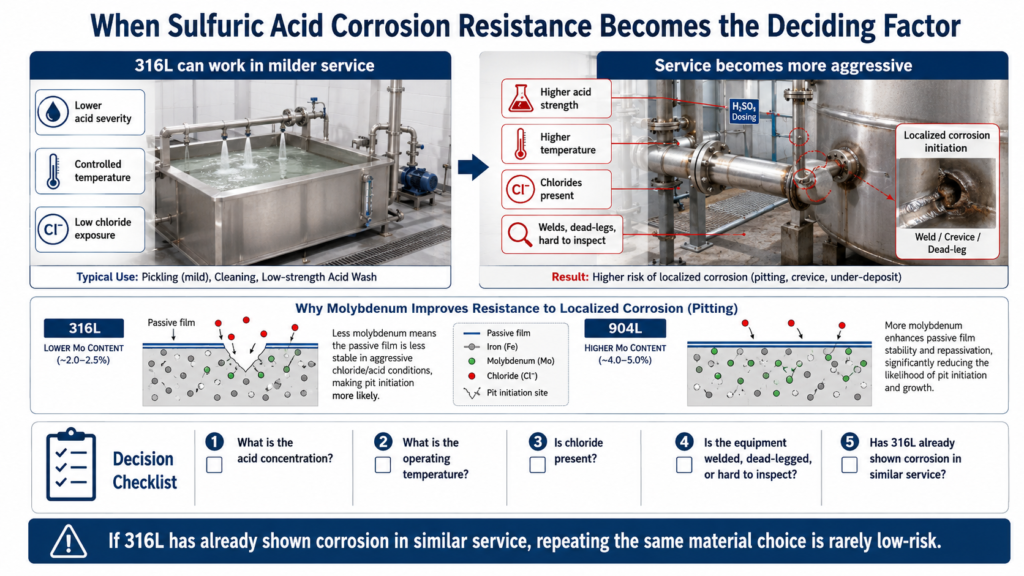
Is Sulfuric Acid Corrosion Resistance the Real Break Point?
In many buying decisions, yes.
The phrase sulfuric acid corrosion resistance is not just technical language. It is often the dividing line between “316L is fine” and “316L keeps causing trouble.”
That is exactly why plant failures happen. A buyer may read “316L stainless steel” on one successful project and assume the same grade is safe in another acid line, wash tank, or dosing system. But a change in acid strength, chlorides, or temperature can move the service into a much more aggressive corrosion range.
The IMOA educational module on corrosion resistance of stainless steels also explains why molybdenum improves resistance to localized corrosion such as pitting. That matters because many equipment failures begin as small, local attacks rather than general metal loss across the whole surface.
So, in 904L stainless steel vs 316L, the sulfuric acid question should be framed like this:
- What is the acid concentration?
- What is the operating temperature?
- Is chloride present?
- Is the equipment welded, dead-legged, or hard to inspect?
- Has 316L already shown corrosion in similar service?
If the answer to that last question is yes, repeating the same material choice is rarely a low-risk move.
904L vs 316L Cost vs Performance: What Are You Really Paying For?
This is where many comparisons go wrong.
They compare price per kilogram, then stop.
But 904L vs 316L cost vs performance should be judged against the full cost of service, not just the purchase order line.
Here is the more useful comparison:
| Cost Question | 316L | 904L |
|---|---|---|
| Initial material price | Lower | Higher |
| Fabrication familiarity | Usually easier | May need closer sourcing control |
| Resistance margin in severe acid service | Narrower | Wider |
| Risk of repeated maintenance | Higher in wrong service | Lower in the right service |
| Shutdown cost exposure | Can be significant | Often lower if corrosion is reduced |
That table only matters if you connect it to plant reality.
If the equipment is a simple, replaceable part in mild service, 316L may still be the smarter buy. But if the system is part of a continuous production line, a reactor feed loop, a chemical storage section, or a pharmaceutical cleaning circuit where contamination or leakage is costly, then the comparison changes.
One leak can erase the material savings very quickly.
That is why 904L stainless steel vs 316L should be treated as a risk-and-lifecycle decision, not a catalog-grade debate.
Where Are Buyers Most Likely to Regret Choosing 316L?
Usually in places where the service looks manageable on paper but becomes harsher in operation.
Typical examples include:
- sulfuric acid handling systems
- chemical dosing skids
- CIP systems with aggressive cleaning chemistry
- pharmaceutical vessels with repeated acidic cleaning
- chloride-bearing wash or process streams
- heat exchangers with crevices or stagnant zones
- welded tanks and pipework that are difficult to inspect internally
Welds deserve special attention. The TWI FAQ on heat tint during welding explains that heat tint can make stainless steel more susceptible to pitting and crevice corrosion if it is not properly controlled or removed. That means even a good alloy choice can underperform if welding and post-weld treatment are weak.
So the material question should never be separated from the fabrication question.
When Is 316L Still the Better Choice?
This part matters because not every system needs upgrading.
316L still makes sense when:
- the process is only mildly corrosive
- sulfuric acid is not present, or exposure is limited and controlled
- chloride levels are low
- temperature is moderate
- the equipment is easy to inspect and replace
- cost pressure is high and corrosion history is clean
In many food, water, mild pharmaceutical, and general process systems, 316L is still a practical and proven grade.
The point of 904L stainless steel vs 316L is not to turn every project into a 904L project. It is to avoid forcing 316L into a job that has already shown it is too aggressive.
What Should Buyers Check Before Replacing 316L with 904L?
Before changing grade, ask for real operating data.
Use this checklist:
1.Define the medium clearly:Acid type alone is not enough. Confirm concentration, chlorides, cleaning chemicals, and contaminants.
2.Check actual temperature:Corrosion behavior can change fast once temperature rises.
3.Review failure history:Was the problem pitting, crevice corrosion, weld attack, or general thinning?
4.Look at fabrication details:Welds, dead legs, gaskets, rough surfaces, and poor drainage can make service more aggressive.
5.Compare downtime cost:If a failure shuts down production, material savings may be a false economy.
6.Verify sourcing and certification:Ask for MTCs, chemistry confirmation, and weld guidance for the selected grade.
Final Takeaway
904L stainless steel vs 316L is not really a debate about which alloy looks better on a datasheet. It is a question of whether the service environment is mild enough for 316L to remain economical, or aggressive enough that 904L becomes the safer long-term choice.
If your system involves sulfuric acid, chlorides, difficult shutdowns, or repeated corrosion around welds and crevices, material price should not be the only number in the room. In that kind of service, the better decision is usually the one that reduces the chance of leakage, contamination, and avoidable downtime.
FAQ
Is 904L better than 316L?
Not in every service. 904L is usually better in more aggressive acidic or chloride-containing environments, but 316L is often the more practical choice in mild to moderate service.
Why is 904L better in sulfuric acid service?
Because its higher nickel, higher molybdenum, and copper content give it better sulfuric acid corrosion resistance than 316L in many operating conditions.
Is 904L worth the extra cost?
It can be, especially when the alternative is repeated corrosion, leakage, cleaning contamination, or production stoppage. That is the core of 904L vs 316L cost vs performance.
Can 316L be used in sulfuric acid?
Sometimes, yes—but only after checking concentration, temperature, and process details carefully. It should never be assumed safe in all sulfuric acid service.
Where does corrosion often start first?
Often at welds, crevices, deposits, gasketed joints, or stagnant zones rather than on open flat surfaces.
Should pharmaceutical equipment always use 904L?
No. Many pharmaceutical systems run successfully in 316L. 904L becomes more relevant when acidic cleaning, chloride exposure, or corrosion history pushes the service beyond what 316L handles comfortably.