
1.2379 vs D2 steel is not only a hardness comparison. For European mold export projects, the real question is whether the material can pass the drawing, standard system, MTC, heat treatment, and customer approval. This guide shows when substitution may work, when it is risky, and how buyers should review German tool steel vs American standard before cutting mold parts. For buyers, 1.2379 vs D2 steel should start with evidence, not assumption.
Is 1.2379 the Same as D2 Steel?
1.2379 vs D2 steel is usually treated as a close equivalent comparison. Both are high-carbon, high-chromium cold work tool steels used for blanking dies, punches, shear blades, cold forming tools, and wear-resistant mold inserts.
But “equivalent” does not mean “automatically accepted.” If a European drawing calls for 1.2379 or X153CrMoV12, the buyer should not approve D2 only by name. Drawing language, customer approval, chemical range, delivery condition, and material certificate all matter.
The ISO 4957 tool steel standard page describes tool steel categories such as non-alloy cold-work, alloy cold-work, hot-work, and high-speed tool steels. In the American system, ASTM A681 covers chemical, mechanical, and physical requirements for wrought alloy tool steel products.
That is why 1.2379 vs D2 steel should be reviewed as a compliance decision, not just a grade-name match.
DIN vs AISI Tool Steel: What Changes in the Standard System?
DIN vs AISI tool steel matters because the steel may be similar, but the documentation language is different.
DIN 1.2379 is a German material number. X153CrMoV12 is the European grade name. D2 is the AISI/ASTM designation used in the American system.
For export molds, this can affect customer approval. A European buyer may ask for EN ISO 4957, EN 10204 inspection documents, or a certificate that clearly states the European material designation. So, 1.2379 vs D2 steel is also a communication issue. If the quote says D2 but the drawing says 1.2379, submit an equivalence note before production begins.
1.2379 vs D2 Steel Chemical Composition: What Should Buyers Check?
In 1.2379 vs D2 steel comparison, chemical composition is the first checkpoint. Both belong to the high-carbon, high-chromium family, but actual values must be checked on the MTC.
| Checkpoint | Why It Matters |
|---|---|
| Carbon | Controls hardness and carbide volume |
| Chromium | Supports wear resistance and hardenability |
| Mo / V | Affects heat treatment response |
| P and S | Influence cleanliness and chipping risk |
| Heat analysis | Proves what was supplied |
| Checkpoint | Why It Matters |
|---|---|
| Carbon | Controls hardness and carbide volume |
| Chromium | Supports wear resistance and hardenability |
| Mo / V | Affects heat treatment response |
| P and S | Influence cleanliness and chipping risk |
| Heat analysis | Proves what was supplied |
| Checkpoint | Why It Matters |
|---|---|
| Carbon | Controls hardness and carbide volume |
| Chromium | Supports wear resistance and hardenability |
| Mo / V | Affects heat treatment response |
| P and S | Influence cleanliness and chipping risk |
| Heat analysis | Proves what was supplied |
The AZoM D2 tool steel data page lists D2 as a high-carbon, high-chromium cold-work steel and shows typical composition, hardness, heat treatment, and applications. Use this as reference only; the mill certificate should control the purchase decision. For buyers, 1.2379 vs D2 steel starts with chemistry proof.
Why Do European Mold Buyers Care About Toughness and Chipping Risk?
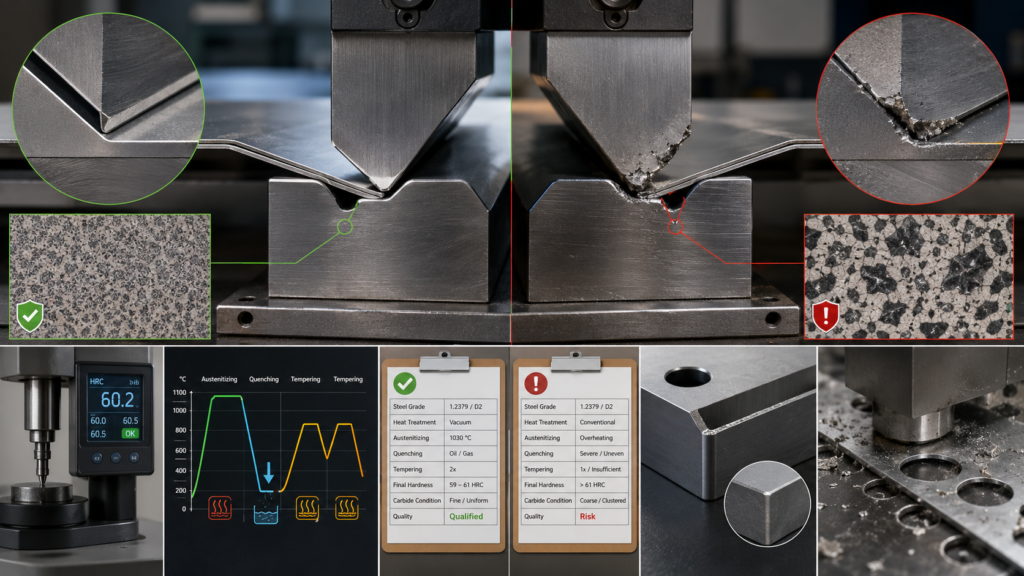
1.2379 vs D2 steel should not be decided by wear resistance alone. Both grades can provide strong abrasion resistance, but high carbide content can reduce edge toughness if steelmaking, heat treatment, or carbide distribution is poor.
The ASM Digital Library chapter on high-carbon, high-chromium cold-work tool steels explains that AISI D-series steels are high-carbon, high-chromium cold-work steels and discusses microstructure, hardenability, hardening, tempering, selection, and applications.
Thin cutting edges, sharp corners, wire-cut inserts, high-speed stamping tools, and abrasive sheet metal contact are less forgiving. In those cases, 1.2379 vs D2 steel should be checked through heat treatment route, final hardness, carbide condition, and application load.
Can D2 Replace 1.2379 for European Mold Drawings?
D2 can replace 1.2379 only when the customer or drawing allows equivalent material. The supplier should not assume approval.
Before substitution, confirm:
- the drawing allows equivalent grade;
- the customer accepts AISI D2;
- the MTC shows acceptable chemistry;
- delivery condition is annealed or heat treated as required;
- final hardness matches the mold design;
- heat treatment records are available;
- chipping risk is acceptable.
This is the real buying question behind 1.2379 vs D2 steel. The safer answer is not “yes” or “no”; it is “prove the equivalence before machining.”
How Should Buyers Verify 1.2379 and D2 on the MTC?
For 1.2379 vs D2 steel, the MTC should show more than a grade label. Buyers should check grade designation, standard reference, heat number, chemical composition, annealed hardness, delivery condition, size tolerance, and inspection status.
If the MTC only says “D2 equivalent to 1.2379” without heat analysis or standard reference, buyers should ask for clarification. In export molds, 1.2379 vs D2 steel must be traceable.
When Should You Avoid Simple Substitution?
Simple substitution is risky when the drawing strictly states 1.2379 only, the mold has thin cutting edges, EDM wire-cut corners, high chipping history, or the heat treatment procedure is fixed by the customer.
Avoid quick approval when the supplier cannot provide MTC, heat number traceability, hardness condition, or a clear DIN vs AISI tool steel explanation. 1.2379 vs D2 steel becomes especially sensitive in precision blanking, cold extrusion, thread rolling, and high-volume stamping.
Best Buying Practice for German Tool Steel vs American Standard
For German tool steel vs American standard, ask which certificate, heat treatment route, and acceptance rule matches the job.
Use this buying flow:
1.Start with the mold drawing.
2.Confirm allowed material designation.
3.Compare chemical composition.
4.Review MTC and heat number.
5.Confirm annealed or hardened condition.
6.Check final hardness and tempering requirement.
7.Get customer approval before substitution.
In short, 1.2379 vs D2 steel is a standard-control and risk-control topic.
Conclusion
1.2379 vs D2 steel is best understood as a near-equivalent comparison that still requires proof. For European mold export projects, the grade name alone is not enough. Buyers should verify DIN vs AISI tool steel requirements, chemical composition, MTC, heat treatment, hardness, and chipping risk before approving substitution. When documentation is clear, D2 may work well. When evidence is weak, follow the European drawing exactly. This is why 1.2379 vs D2 steel should always be confirmed before machining.
FAQ
Is 1.2379 the same as D2 steel?
They are close equivalent cold work tool steels, but buyers should check standard, chemistry, MTC, delivery condition, and customer approval.
What is 1.2379 steel equivalent to?
1.2379 is commonly compared with X153CrMoV12 and AISI D2. Exact substitution depends on the required standard and certificate.
Can D2 replace 1.2379 in European mold projects?
Yes, if the drawing allows equivalent material and the customer accepts D2 with proper MTC, chemistry, heat treatment, and hardness evidence.
What is the difference between DIN and AISI tool steel?
DIN uses German and European designation systems such as material number 1.2379. AISI uses American grade names such as D2.
Does 1.2379 have better toughness than D2?
Not automatically. Toughness depends on steelmaking quality, carbide distribution, heat treatment, hardness, and application geometry.
What should buyers check before approving substitution?
Check drawing requirement, standard reference, MTC, heat number, chemical analysis, delivery condition, heat treatment record, final hardness, and customer approval.