
Losing a week of toolmaking labor because a die block warped 0.1mm during the final quench is a shop floor nightmare. When deciding between A2 vs O2 steel, the choice rarely comes down to just final hardness. It is a strict battle of dimensional stability against initial machining speed.
If you are building complex, high-tolerance progressive dies, air-hardening AISI A2 is mandatory to prevent heat treat distortion. If you need a cheap, easy-to-machine die block for short runs where grinding allowances are loose, AISI O2 works.
This breakdown skips the generic spec sheets and analyzes exactly how these two cold work steel grades react to thermal shock, EDM wire cutting, and continuous stamping impact.
Why Does A2 vs O2 Steel Heat Treatment Distortion Dictate Tooling Costs?
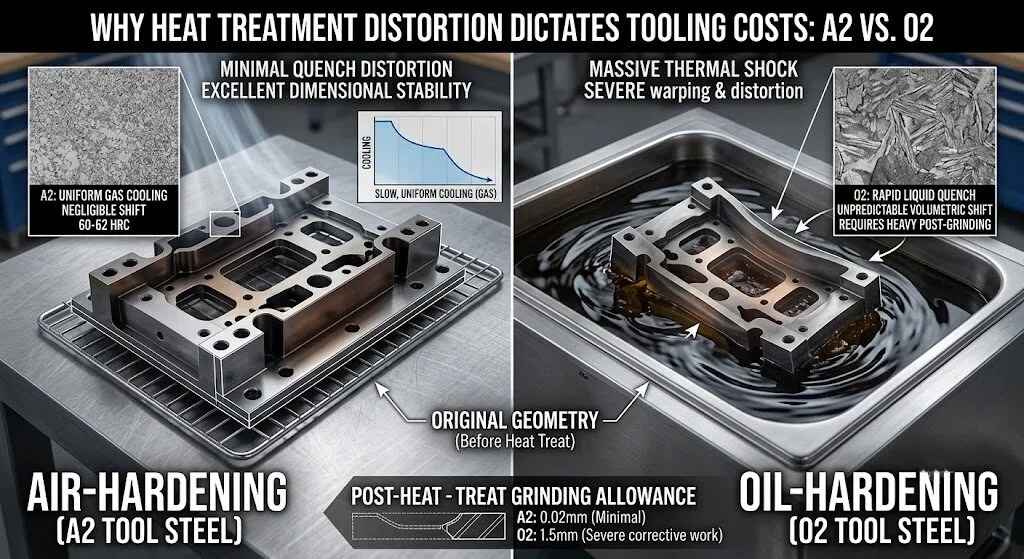
Dimensional distortion during heat treatment dictates your final tool cost and lead time. O2 is an oil-hardening grade. Dropping a red-hot, intricately machined O2 punch into a liquid oil bath causes massive thermal shock. The outer surface cools and contracts rapidly while the core stays hot, forcing the metal to twist.
A2 completely bypasses this risk. With 5% chromium, it achieves full hardness (60-62 HRC) cooling in still air or a vacuum furnace gas quench. The cooling rate is uniform throughout the entire cross-section, meaning the net volumetric change is almost zero.
To understand why liquid extraction causes unpredictable volumetric shifting, review the metallurgical physics detailed in Quenching and Thermal Stresses on Wikipedia. The drastic cooling curves of oil guarantee some level of bowing. If your die configuration cannot tolerate post-heat-treat grinding to correct for distortion, O2 introduces severe manufacturing risks.
What Is the Difference Between A2 and O2 Tool Steel?
The underlying difference between A2 and O2 tool steel originates within their chemical formulations, which directly control the type and volume of hard carbide phases.
| Performance Metric | AISI A2 Tool Steel AISI A2 | AISI O2 Tool Steel AISI O2 |
| Quenching Medium | Air / Vacuum Gas | Oil |
| Dimensional Stability | Exceptional (Remains flat) | Moderate (Prone to bowing) |
| Abrasive Wear Resistance | High | Low |
| Carbide Structure | Chromium Carbides | Iron/Manganese Carbides |
A2 contains ten times the chromium content of O2. During tempering, this chromium bonds with carbon to form exceptionally hard chromium carbides. These microstructural anchors resist abrasive wear when punching abrasive or high-strength sheet metals.
O2 relies primarily on manganese and carbon. It forms iron carbides, which are softer and less thermally stable. While this gives O2 a remarkably keen cutting edge out of the gate, it lacks the structural armor required for long runs. As explained in the Cold Work Tool Steel Microstructure Analysis on ScienceDirect, chromium-rich matrices provide significantly higher resistance to adhesive wear (galling) under continuous sliding pressures.
O2 relies primarily on manganese and carbon. It forms iron carbides, which are softer and less thermally stable. While this gives O2 a remarkably keen cutting edge out of the gate, it lacks the structural armor required for long runs. As explained in the fundamental metallurgical principles of Galling and Adhesive Wear, chromium-rich matrices provide significantly higher resistance to cold-welding and adhesive wear under continuous sliding pressures compared to lean iron-carbide structures.
Is A2 Tool Steel Harder to Machine Than O2?
Yes. Out of the box in the annealed state, A2 eats carbide inserts faster than O2. O2 is one of the most machinist-friendly tool steels available. You can mill complex pockets and drill tight hole patterns with standard HSS tooling with minimal tool pressure.
However, machining does not stop at the CNC mill. Post-hardening, you have to grind the precision dies.
Because O2 distorts in the oil tank, you must leave extra stock on your dimensions and spend hours on the surface grinder trying to make it flat again. A2 comes out of the furnace nearly perfectly flat. Real toolmakers actively debate this tradeoff. In a detailed shop floor discussion regarding Machining and Grinding A2 vs O2 on Reddit, machinists confirm that the extra time spent milling A2 is immediately recovered because it requires almost zero post-quench grinding.
Wire EDM Risks in Cold Work Steel
Precision dies are rarely just milled; intricate profiles are sliced using Wire Electrical Discharge Machining (EDM).
Cutting oil-quenched O2 with wire EDM is highly risky. The core holds massive residual tensile stress from the oil bath. When the EDM wire cuts through these stress zones, the sudden relief of tension causes the material to micro-crack, warp, or physically pinch the wire.
A2’s uniform air-cooling leaves a stress-relieved matrix that takes EDM cutting beautifully. The micro-cracking risks associated with heavily stressed liquid-quenched blocks are well documented. Tooling supplier Hudson Tool Steel explicitly notes in their Tool Steel EDM Guidelines that air-hardening grades should always be prioritized for complex wire-cut geometries to prevent catastrophic cracking.
A2’s uniform air-cooling leaves a stress-relieved matrix that takes EDM cutting beautifully. The micro-cracking risks associated with heavily stressed liquid-quenched blocks are well documented. The underlying thermodynamics of the heat-affected zone, as detailed in the manufacturing science breakdown of Electrical Discharge Machining, confirm that pre-existing residual tensile stresses from aggressive liquid quenching severely increase the likelihood of micro-cracking during spark erosion. This makes naturally stable, air-hardening grades like A2 the mandatory choice for complex wire-cut geometries.
Toolroom economics dictate that raw material costs are negligible compared to labor hours. Buying O2 saves a few dollars upfront and machines easily, but the unpredictable oil quench forces you into expensive corrective grinding and risky EDM operations. For consistent, tight-tolerance tooling that holds its edge, the dimensional stability of A2 vs O2 steel makes A2 the only logical choice for your press room.
FAQ
Can I use O2 tool steel for heavy-gauge stamping?
No. O2 lacks the primary alloy carbides needed to sustain edge integrity. It will wear rapidly or chip under heavy loads. It is strictly for thin, non-abrasive stocks and short prototype runs.
Why does my O2 punch crack near sharp internal radii?
Oil quenching causes severe stress concentrators at sharp corners. If your design has tight inside radii or close-spaced holes, the thermal shock of the oil bath will cause cracking. Switch to the gentle air quench of A2.
How do I fix A2 steel heat treatment distortion?
Usually, A2 does not distort unless the heat treatment process is flawed. If A2 warps, your furnace ramp-up was too fast or the part was not properly supported on the furnace rack.