
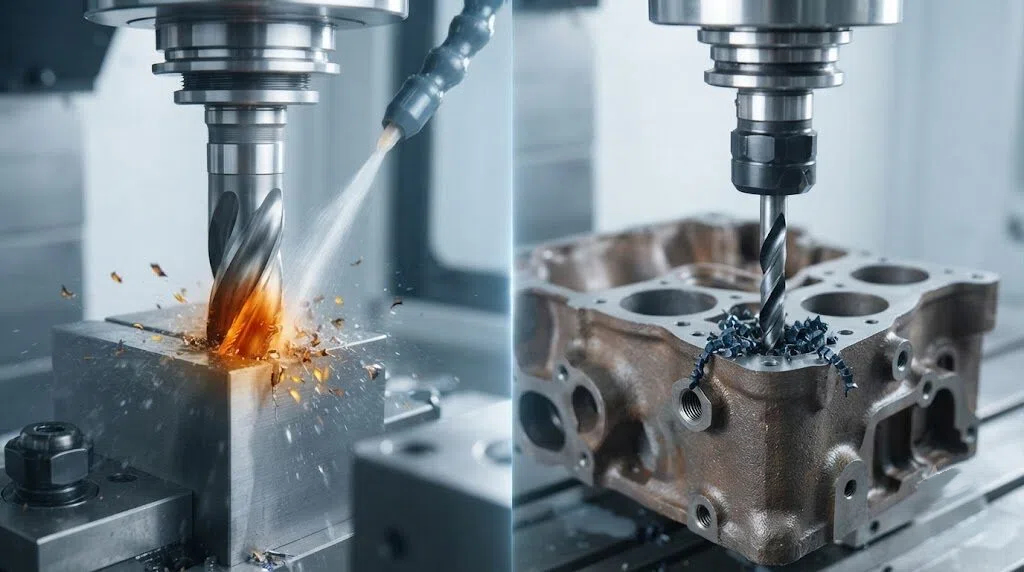
When cutting tools operate at high speeds, the cutting edge generates significant heat. The ability of a material to maintain hardness under elevated temperatures is known as red hardness or hot hardness.
This property is one of the main reasons high speed steel performs differently from conventional tool steels.
During machining operations such as drilling, milling, and turning, the cutting edge can experience temperatures above 500°C. If the steel loses hardness too quickly, the tool edge becomes softer, leading to:
- faster wear
- poor dimensional accuracy
- shorter tool life
- frequent tool changes
According to the ASM International article on high speed steels, alloying elements such as tungsten, molybdenum, and vanadium contribute to the formation of hard carbides that help maintain cutting performance at elevated temperatures.
Does M2 High Speed Steel Have Better Red Hardness Than M7 Steel?
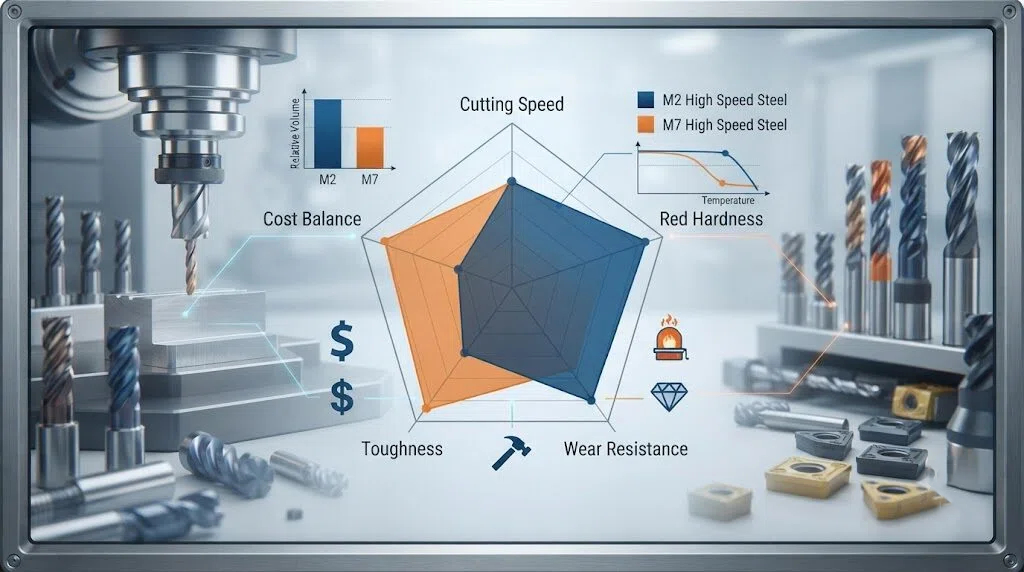
When comparing M7 vs M2 high speed steel, M2 generally has an advantage in high-temperature cutting applications.
The reason comes from its alloy structure.
M2 contains higher levels of tungsten and vanadium compared with many M7 formulations. These elements contribute to carbide formation, which improves:
- hot hardness
- abrasion resistance
- cutting edge retention
This makes M2 especially suitable for:
- high-speed machining
- continuous cutting operations
- harder workpiece materials
- production environments where tool changes affect productivity
However, red hardness is not the only factor that determines tool performance.
M7 steel can still perform effectively when:
- cutting speeds are moderate
- toughness is more important than maximum heat resistance
- machining conditions involve vibration or impact
A tool that fails from chipping before thermal wear becomes a problem does not necessarily benefit from higher red hardness.
Which Grade Has Better Wear Resistance: M7 Steel or M2 Steel?
Wear resistance determines how long a cutting tool maintains its original geometry during machining.
For manufacturers producing:
- drills
- milling cutters
- taps
- industrial blades
wear resistance directly affects production consistency.
M2 steel usually provides stronger wear resistance because of its carbide distribution.
The combination of:
- tungsten carbides
- vanadium carbides
- molybdenum-based strengthening
allows M2 cutting tools to maintain sharp edges during longer machining cycles.
This is why M2 remains one of the most common choices for general-purpose HSS cutting tools.
M7 steel, while still a high speed steel grade, places more emphasis on toughness and balanced performance.
Its advantages may appear in applications where:
- tool impact is frequent
- cutting conditions are unstable
- excessive brittleness creates tool failure
Can M7 Replace M2 High Speed Steel?
The answer is: sometimes, but not universally.
M7 can replace M2 in certain cutting applications, but the decision should be based on machining conditions.
A direct replacement may work when:
✓ Cutting speed is moderate
✓ The workpiece material is not extremely abrasive
✓ Toughness is more important than maximum wear resistance
✓ Tool cost optimization is important
M2 remains the preferred choice when:
✓ Higher cutting speeds are required
✓ Long tool life is the priority
✓ The tool operates under continuous heat generation
✓ Machining harder materials
For example:
A general-purpose drill used in mild steel production may perform well with M7.
However, an industrial milling cutter running continuously in an automated machining center may benefit more from M2.
The correct question is not:
“Which steel grade is stronger?”
The better question is:
“Which steel grade matches the cutting conditions?”
Which Cutting Tools Are Better Suited for M2 HSS?
M2 remains the industry reference grade for many general-purpose cutting tools.
Common applications include:
Drill Bits
M2 drill bits are widely used because they maintain hardness during repeated drilling cycles.
Suitable for:
- carbon steel
- alloy steel
- stainless steel applications with proper cutting parameters
Milling Cutters
M2 milling cutters are selected when manufacturers need:
- stable edge retention
- predictable machining performance
- longer cutting cycles
Taps and Reamers
Threading tools require a balance between hardness and toughness.
M2 provides the necessary combination for many industrial applications.
Where Does M7 Steel Perform Better?
M7 steel is often considered when manufacturers need a more balanced HSS grade.
Potential applications include:
- general machining tools
- economical cutting tool production
- tools exposed to shock loading
- applications where extreme cutting speed is unnecessary
For cutting tool manufacturers, M7 can become an alternative when the goal is reducing material cost while maintaining acceptable performance.
However, tool geometry, heat treatment, coating, and machining parameters can influence final performance as much as the steel grade itself.
What About M2 HSS Alternatives for Cutting Tools?
Some buyers searching for an M2 HSS alternative are actually looking for a different balance between:
- price
- toughness
- cutting speed
- tool life
Possible alternatives include:
- M7 high speed steel
- M42 cobalt high speed steel
- powder metallurgy high speed steel
Each option solves a different problem.
For example:
- M42 improves hot hardness through cobalt addition.
- Powder metallurgy HSS improves carbide distribution and consistency.
- M7 provides a balance between toughness and general cutting performance.
Choosing an alternative requires understanding the actual machining requirements instead of simply replacing one grade with another.
How Should Buyers Choose Between M7 and M2 High Speed Steel?
For cutting tool manufacturers and machining companies, selecting between M7 and M2 should start with the actual working conditions rather than the material price.
Both grades belong to the high speed steel grades family, but they are optimized for different priorities.
A practical selection process should consider the following factors:
1.What Material Will the Cutting Tool Machine?
The workpiece material strongly affects tool steel selection.
For example:
Mild Steel and General Alloy Steel
M2 is commonly selected because it provides a good balance of:
- wear resistance
- hardness
- cutting stability
Softer Materials or General-Purpose Applications
M7 steel can be considered when:
- cutting speed is moderate
- impact resistance is important
- tool cost needs to be controlled
Harder Materials and Continuous Production
M2 or higher-performance HSS grades may be preferred because the cutting edge experiences more heat and friction.
2.Is Tool Life More Important Than Initial Material Cost?
For large-scale production, tool replacement frequency directly affects machining costs.
A tool that lasts longer may reduce:
- machine downtime
- operator intervention
- production interruptions
M2 often has an advantage in applications requiring longer cutting cycles because of its stronger wear resistance.
M7 can be attractive when the machining conditions do not fully utilize M2’s higher wear capability.
3.Are Cutting Conditions Stable or Interrupted?
This is one of the most overlooked factors.
Stable cutting:
- CNC machining centers
- continuous milling
- automated production
Usually favors grades with stronger wear resistance.
Interrupted cutting:
- vibration
- uneven material allowance
- unstable fixtures
May benefit from a tougher grade.
In these cases, M7 steel can provide practical advantages because excessive hardness without enough toughness may increase the risk of edge chipping.
M7 vs M2 High Speed Steel: Quick Selection Guide
| Application Requirement | Recommended Grade |
|---|---|
| General-purpose drills | M2 |
| High-speed machining | M2 |
| Long production cycles | M2 |
| Moderate cutting speed | M7 |
| Need for toughness | M7 |
| Cost-sensitive tool production | M7 |
| Premium cutting performance | M2 or higher HSS grades |
The decision between M7 vs M2 HSS is not about finding an absolute winner. It is about matching the steel grade with the machining environment.
Final Thoughts
When comparing M7 vs M2 high speed steel, the right choice depends on how the tool will actually operate.
M2 remains the standard choice for many general cutting tools because of its strong wear resistance, red hardness, and proven machining performance.
M7 steel is not simply a cheaper replacement. It can be a suitable alternative when toughness, balanced performance, and application requirements are more important than maximum cutting speed.
For tool manufacturers and industrial buyers, selecting the correct HSS tool steel grade means evaluating the complete machining environment, including cutting speed, workpiece material, production volume, and expected tool life.
FAQ
Is M7 steel better than M2 high speed steel?
Not always. M7 provides good toughness and balanced performance, while M2 generally offers better wear resistance and high-temperature cutting performance.
Can M7 replace M2 high speed steel?
M7 can replace M2 in some general cutting applications, but M2 remains preferable for high-speed machining and applications requiring longer tool life.
Which HSS grade is better for drill bits?
M2 is one of the most common choices for drill bits because it provides a strong balance of hardness, wear resistance, and toughness.
What is the main advantage of M7 steel?
The main advantage of M7 steel is its balanced performance, especially where toughness and cost control are important.
Does higher hardness always mean better cutting performance?
No. Cutting performance depends on hardness, toughness, red hardness, carbide structure, heat treatment, and machining conditions.
Is M2 a good general-purpose HSS steel?
Yes. M2 is widely used for general cutting tools because it performs well across many machining applications.