
Choosing between D6 vs D3 tool steel usually comes down to one harsh reality: how many cycles your stamping dies can handle before they chip or wear out. We skip the basic datasheets here. Instead, we break down the specific chemical differences, the real-world abrasive friction limits, and the exact heat treatment risks that cause these high carbon tool steel blocks to fail prematurely on the press floor.
What Causes the Performance Gap in D6 vs D3 Tool Steel?
The core differentiator when analyzing D6 vs D3 tool steel is the addition of tungsten (W) in the D6 chemistry. D3 steel relies strictly on a massive 12% chromium and 2% carbon load to form chromium carbides. D6 steel takes that exact same base and adds approximately 1% tungsten.
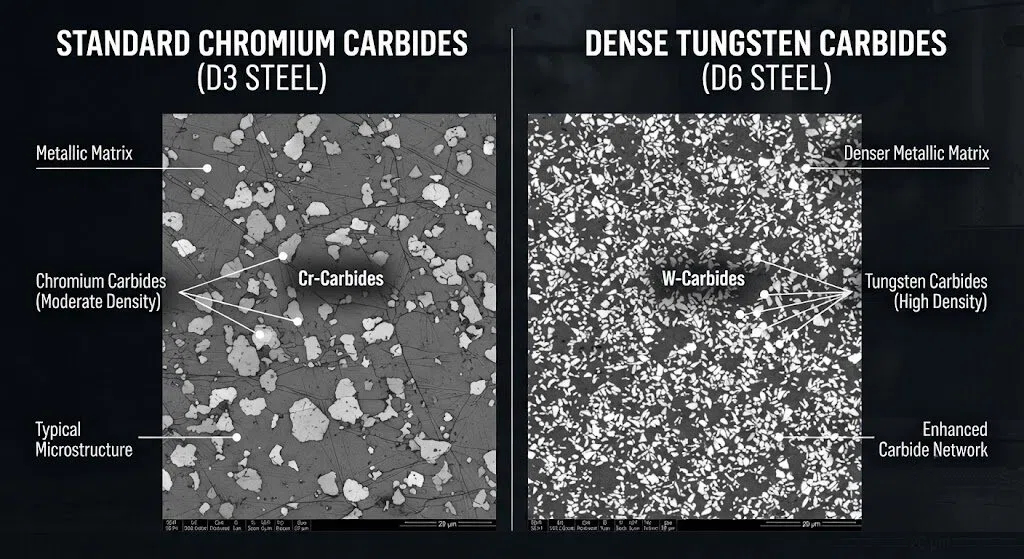
According to metallurgical breakdown data on alloying elements in high-carbon steels published by MatWeb, tungsten forms extremely hard, complex carbides during the heating cycle. These tungsten carbides are physically harder than chromium carbides. When the sheet metal scales drag across your die radius, the tungsten prevents the metal matrix from washing out.
Is Tungsten the Only Reason to Choose D6 Steel for Cutting Dies?
When you specify a material, understanding the abrasive friction limits of D6 vs D3 tool steel dictates your tooling lifespan. Tungsten does more than resist friction; it slightly increases the red hardness of the block. If you run high-stroke-rate progressive dies, the cutting edges get hot. D3 tends to lose its edge retention faster when temperatures climb at the localized shear zone.
In heavy sheet metal stamping, the true test of D6 vs D3 tool steel happens at the die edge. Abrasive wear from scaled hot-rolled steel will quickly round off a D3 edge. D6 maintains that sharp shear angle longer, directly reducing the burr on your stamped parts. As detailed in technical stamping articles by The Fabricator on reducing burrs in metal stamping, holding shear edge geometry is the primary factor in minimizing secondary deburring operations and preventing punch galling.
D6 vs D3 Wear Resistance: Surviving Abrasive Friction
A direct look at D6 vs D3 tool steel under a microscope reveals denser carbide distribution in the tungsten-alloyed matrix. However, this superior wear resistance comes with a strict fabrication penalty.
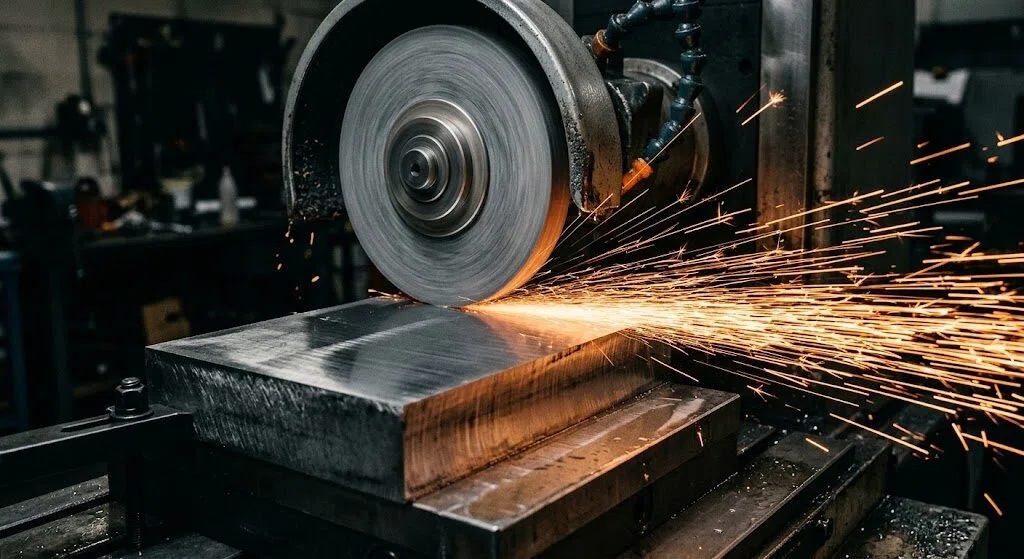
Machine shops running D6 vs D3 tool steel notice immediate differences during the secondary grinding phase. D6 will glaze grinding wheels much faster. The hardness of tungsten carbides reaches up to 2400 HV, compared to chromium carbides which max out around 1500 HV. When the aluminum oxide grains on your grinding wheel hit these tungsten particles, the abrasive grains dull instantly. You must use softer bond wheels and dress them more frequently. If the operator forces the feed rate, surface burning occurs, dropping the local hardness and ruining the wear resistance you specifically paid for.
Why Do Dies Crack During Quenching?
Anyone heat treating D6 vs D3 tool steel knows the cracking risks associated with high carbon tool steel. Both materials sit at the extreme end of the brittleness spectrum, leaving zero room for error during the quench.
Because D6 vs D3 tool steel differ in their critical transformation temperatures, your heat treater cannot use the exact same recipe. D6 requires a slightly higher austenitizing temperature to properly dissolve the tungsten into the matrix. If your heat treater simply runs D6 on a standard D3 cycle, you get retained austenite. This retained structure later transforms into untempered martensite during mechanical operation, leading to sudden, catastrophic die shattering under the press load.
Advanced studies on carbide distribution in hyper-eutectoid alloys (as discussed in literature indexed on ScienceDirect) emphasize that rapid quenching of D3/D6 steels often triggers premature failure due to internal thermal stresses. Modern industrial standards mandate the use of multi-bar nitrogen quenching to ensure core stability (Reference: ASM Handbook Vol. 4/Vacuum Heat Treating Standards).
Furthermore, wire EDM processes also expose the flaws in improperly tempered D6 vs D3 tool steel. The localized melting zone from the EDM wire reaches temperatures exceeding 8000°C, leaving a recast layer that is highly stressed. If the block was not multi-tempered to absolute stability, the EDM process will initiate microscopic cracks that propagate the moment the die takes its first impact load. Machinists frequently discuss these exact failure modes, with real shop-floor feedback in r/Machinists confirming that skipping a post-EDM stress-relief cycle is the leading cause of D-series tool failure.
Material Selection Matrix
From a procurement standpoint, sourcing D6 vs D3 tool steel requires checking the mill test certificates for carbide segregation. Poorly poured ingots will have massive carbide banding, creating distinct weak lines in the steel regardless of your heat treatment.
| Application Constraint | D3 Steel Capability | D6 Steel Capability | Procurement Decision Driver |
| Abrasive Wear | Standard | Superior | Choose D6 if stamping scaled, thick, or hard-to-shear materials. |
| Impact Loading | Very Poor | Very Poor | If impact shock is high, neither works. Switch to A2 or O2 steel. |
| Grindability | Moderate | Difficult | D3 reduces secondary tooling and abrasive costs if complex profile grinding is required. |
If you find that the extreme brittleness of the D-series is causing punch heads to snap off regardless of how well you temper them, you are using the wrong alloy family entirely. You need to step down in carbon and prioritize toughness. Check our detailed engineering breakdown on A2 vs O2 Steel for precision dies
to understand how to balance wear with shock resistance for delicate geometries.
Review your tooling failure logs; if abrasive wear is your primary enemy, upgrading the alloy makes mathematical sense, but always verify your heat treater’s gas quenching capabilities before finalizing your order for D6 vs D3 tool steel.
FAQ
Which is harder after heat treatment, D6 vs D3 tool steel?
They both reach similar maximum bulk hardness levels (typically 58-62 HRC). The difference is not the bulk hardness reading on a Rockwell tester, but the micro-hardness of the specific carbides within the steel structure. D6 contains tungsten carbides, which resist abrasion better than the chromium carbides in D3. The crystallographic structure of Tungsten provides higher localized resistance to surface galling, giving D6 the edge in tool life even if both blocks test at 60 HRC.
Can I weld D6 vs D3 tool steel to repair a chipped die edge?
Technically yes, but practically it is a severe risk. Both materials possess extreme carbon equivalents, meaning the Heat Affected Zone (HAZ) will almost certainly crack during cooling. You must pre-heat the entire block to 400°C (750°F), maintain that temperature during welding, and immediately post-weld temper it. Never attempt a cold TIG repair on these alloys.
How does the machinability compare between D6 vs D3 tool steel?
D3 is noticeably easier to machine in the annealed state. The tungsten in D6 makes the chip formation “gummier” and far more abrasive to carbide cutting tools. Expect to decrease your surface feet per minute (SFM) by roughly 15-20% when milling D6 compared to D3 to maintain your insert life.
Are the cooling fluids different when machining D6 vs D3 tool steel?
No. Both require heavy flood coolant during rough CNC machining to evacuate chips and prevent work hardening of the surface. However, during precision grinding, D6 requires a higher-lubricity coolant mixture to prevent the wheel from loading up with the abrasive W-carbide dust.
What is the price difference between D6 vs D3 tool steel?
D6 commands a premium over D3, strictly due to the raw commodity cost of the tungsten addition. You are paying heavily for that specific element. Do not specify D6 unless your tooling failure analysis explicitly identifies abrasive edge wear as the primary limiting factor of your die life.