
SKD61 vs H13 is a real sourcing question, not just a steel-grade comparison. When a Japanese drawing specifies SKD61, many factories ask whether AISI H13 can be accepted as an equivalent hot work tool steel. The short answer: often yes, but not automatically. This guide explains what buyers, toolmakers, and heat-treatment suppliers should check before approving substitution, including JIS vs AISI tool steel standards, composition, heat treatment, hardness, inspection, and customer approval.
SKD61 vs H13: Quick Answer for Buyers and Toolmakers
SKD61 and H13 are widely treated as comparable chromium-molybdenum-vanadium hot work tool steels. They are used for die casting dies, hot forging dies, extrusion tooling, hot shear tools, and other high-temperature mold applications.
However, SKD61 vs H13 should not be approved only by looking at an equivalent-grade table. Equivalent does not always mean interchangeable.
If the drawing says “SKD61 or equivalent,” H13 may be acceptable after technical review. If the drawing says “SKD61 only,” the factory should not change the grade without written approval.
A practical rule is simple: compare the standard, chemical composition, delivery condition, heat treatment route, hardness range, testing requirements, and material certificate before accepting H13 as an SKD61 substitute.
What Is SKD61 Steel Under JIS?
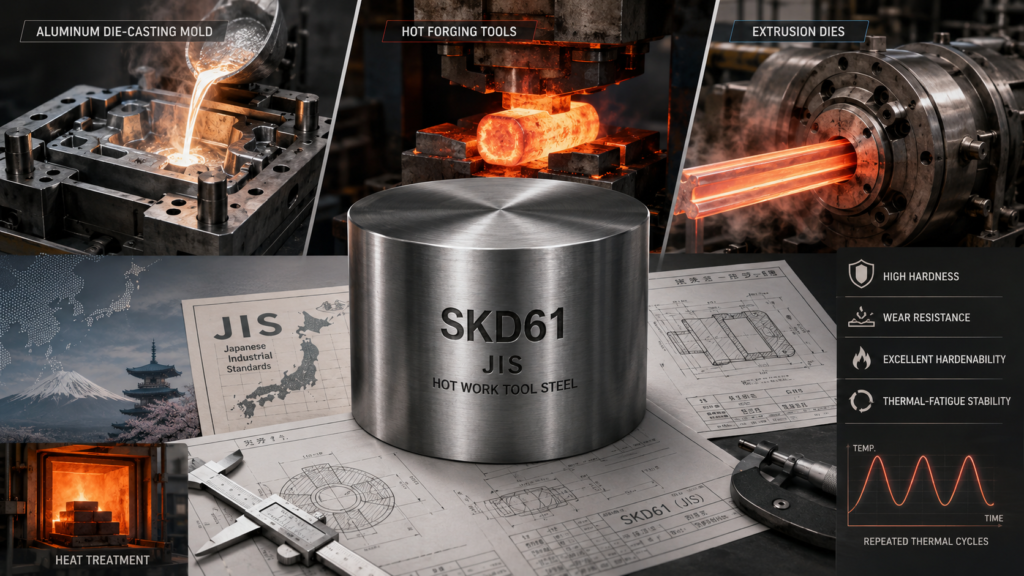
SKD61 is a Japanese JIS hot work tool steel used in molds and tooling exposed to heat, pressure, and repeated thermal cycles. The material is common in Japanese drawings, Asian tooling projects, and die-making supply chains. For SKD61 vs H13 comparison, this JIS naming context is the first thing buyers should understand.
A supplier data page from JFS Steel on SKD61 describes SKD61 as a tool and mold steel with hardness and wear resistance after heat treatment, and lists ASTM H13 as an equivalent grade. That makes the international connection clear, but it still does not replace project-specific approval.
In practice, SKD61 material is often selected for aluminum die casting molds, hot forging tools, extrusion dies, and other hot work applications where thermal fatigue stability and hardenability matter.
What Is H13 Tool Steel Under AISI / ASTM?
H13 is one of the most recognized AISI hot work tool steel grades. According to MatWeb’s AISI Type H13 data sheet, H13 offers high hardenability, wear resistance, hot toughness, and thermal shock resistance.
The AZoM H13 tool steel article lists JIS SKD61 among the equivalent designations for H13 tool steel. This is why SKD61 vs H13 appears so often in international sourcing.
Still, buyers should remember that H13 is not only a name. Steelmaker quality, refining route, ESR requirement, heat treatment, and final hardness can change tool performance.
Is SKD61 Exactly the Same as H13?
The direct answer to “is SKD61 exactly the same as H13” is no. SKD61 and H13 are closely comparable, but they are not automatically identical under every drawing, purchase order, or inspection standard.
The first difference is the standard system. SKD61 belongs to the JIS tool steel naming system, while H13 is commonly used in the AISI / ASTM system. This is the core JIS vs AISI tool steel issue: the names may point to similar materials, but the acceptance rules may not be the same.
The second difference is procurement control. One buyer may require standard-grade material. Another may require ESR, ultrasonic testing, impact toughness, grain size control, or strict hardness after heat treatment.
So the best answer in SKD61 vs H13 decisions is not “yes” or “no.” The better answer is: comparable grade, conditional substitution.
Why JIS vs AISI Tool Steel Standards Matter in Trade
International tooling projects often fail because teams use grade names too loosely. A Japanese customer may write SKD61 on the drawing because that is the familiar JIS designation. A supplier may quote H13 because that is available in local stock.
That does not make the substitution wrong. It only means the substitution must be documented.
JIS vs AISI tool steel comparison should include:
- the exact standard or material specification
- the chemical composition range
- the required delivery condition
- heat treatment responsibility
- final hardness range
- inspection and test requirements
- certificate wording
- written customer approval
This is where SKD61 vs H13 becomes a commercial risk issue as much as a metallurgical one.
SKD61 vs H13 Chemical Composition: What Should Be Compared?
The chemistry of SKD61 and H13 is usually similar because both belong to the Cr-Mo-V hot work tool steel family. The key alloying elements are carbon, chromium, molybdenum, vanadium, silicon, and manganese.
| Element | Why Buyers Should Check It |
|---|---|
| Carbon | Affects hardness, strength, and heat-treatment response |
| Chromium | Supports hardenability, hot strength, and oxidation resistance |
| Molybdenum | Improves temper resistance and high-temperature strength |
| Vanadium | Supports wear resistance and grain refinement |
| Silicon | Helps oxidation resistance and hardenability |
| Manganese | Supports hardenability and processing stability |
For H13, the AZoM chromium hot-work steels article explains that H11, H12, and H13 are commonly used chromium hot-work steels and can be air hardened because of their balanced alloy content.
A composition match is important, but it is only the first checkpoint. In SKD61 vs H13 approval, chemistry should be reviewed together with heat treatment and performance requirements.
Heat Treatment Can Change the Result More Than the Grade Name
Heat treatment is often more important than the grade name printed on the quotation. SKD61 and H13 both rely on correct hardening and tempering to reach the required balance of hardness, toughness, and thermal fatigue resistance.
A Gear Solutions failure analysis article on H13 forging dies discusses how hardening heat treatment and microstructure are critical in forging die quality analysis. That point is highly relevant to SKD61 vs H13 decisions.
If the heat treatment is wrong, an equivalent steel can still fail early. If the heat treatment is well controlled, H13 may perform acceptably in many SKD61 applications.
Buyers should ask for the target hardness, tempering condition, heat-treatment record, and whether the supplier or customer is responsible for final heat treatment.
When Can H13 Replace SKD61?
H13 can replace SKD61 in many projects when the engineering and commercial conditions are clear.
H13 is more likely to be accepted when:
1.the drawing allows equivalent material
2.the chemical composition matches the required range
3.the delivery condition is agreed
4.the target hardness is the same
5.heat treatment requirements are confirmed
6.inspection requirements are met
7.the material certificate clearly identifies the grade
8.the customer or engineer gives written approval
This is the safe way to handle SKD61 vs H13 in international purchasing. It protects the buyer, the factory, and the end customer.
When Should You Not Replace SKD61 Directly?
Do not treat H13 substitution as a shortcut when the application is critical.
Avoid direct replacement if:
- the drawing clearly states “SKD61 only”
- the customer requires JIS material without alternatives
- die life responsibility is high
- ESR or premium hot work steel is specified
- ultrasonic testing is required
- impact toughness is part of acceptance
- the die works under severe thermal cycling
- there is no written approval
The MDPI study on thermal fatigue in H13 die casting samples is a useful reminder that hot work tooling performance is strongly linked to thermal fatigue behavior, not just nominal steel grade.
For die casting dies, extrusion dies, and hot forging tools, material substitution should be treated as an engineering approval process. In SKD61 vs H13 substitution, the cost of one failed die can be higher than the cost of asking for approval.
SKD61 vs H13 for Die Casting, Forging, and Extrusion Dies
In die casting, the main concern is usually heat checking, erosion, thermal fatigue, and dimensional stability. The Wikipedia article on die casting notes that die casting die failure can involve wear, erosion, heat checking, and thermal fatigue.
In hot forging, the concern is impact load, cracking resistance, and hot strength. In extrusion tooling, the concern is hot wear, temper resistance, and dimensional stability.
For these applications, SKD61 vs H13 should be evaluated by operating temperature, thermal cycling, cooling method, surface treatment, hardness, and expected tool life.
Conclusion
SKD61 vs H13 should be handled carefully in international tooling projects. The two grades are closely comparable and often treated as equivalents, but H13 should not replace SKD61 automatically just because it appears in an equivalent table. Buyers should verify JIS vs AISI tool steel requirements, chemical composition, heat treatment, hardness, inspection, material certificate, and written approval. If those conditions are clear, H13 can often be a practical substitute; if they are not clear, the safer choice is to ask before production starts.
FAQ
Is SKD61 exactly the same as H13?
No. SKD61 and H13 are comparable hot work tool steels, but they are not automatically identical under every drawing, standard, or purchase specification. That is why SKD61 vs H13 should always be checked against the project document.
Can H13 replace SKD61?
Yes, in many cases. Buyers must confirm composition, heat treatment, hardness, delivery condition, inspection requirements, and customer approval.
What is the main difference between SKD61 and H13?
The main difference is the standard system. SKD61 belongs to the JIS system, while H13 is commonly used under the AISI / ASTM system.
Is SKD61 better than H13?
Not necessarily. Performance depends on melting quality, heat treatment, hardness, toughness, inspection level, and application conditions.
Which is better for die casting dies?
Both may be used. The better choice depends on thermal fatigue resistance, heat treatment quality, toughness, surface treatment, and customer specification.