
In the high-stakes world of optical molding—think smartphone camera lenses, light guides for EVs, and VR headset components—there is zero margin for error. You have likely experienced the “Mirror Trap”: you spend forty hours on a manual polish, only to have a cluster of microscopic pinholes or “white spots” appear at the #10000 grit stage. It is a nightmare that drains budgets and pushes lead times into the red. Most of the time, the failure isn’t the polisher’s technique; it’s the molecular integrity of the metal itself. This is exactly where NAK80 mold steel enters the conversation as the industry benchmark for “Zero-Tolerance” surface finishes.
Why Purity in NAK80 Mold Steel Matters
When we talk about a Grade #14000 finish, we are discussing a surface that must be free of inclusions. Standard tool steels often contain microscopic sulfur or non-metallic impurities. During the polishing process, these impurities act differently than the steel matrix. As you oscillate your polishing tool, these particles are either torn out—leaving a pinhole—or they stand proud, creating a “white spot” that ruins light refraction.
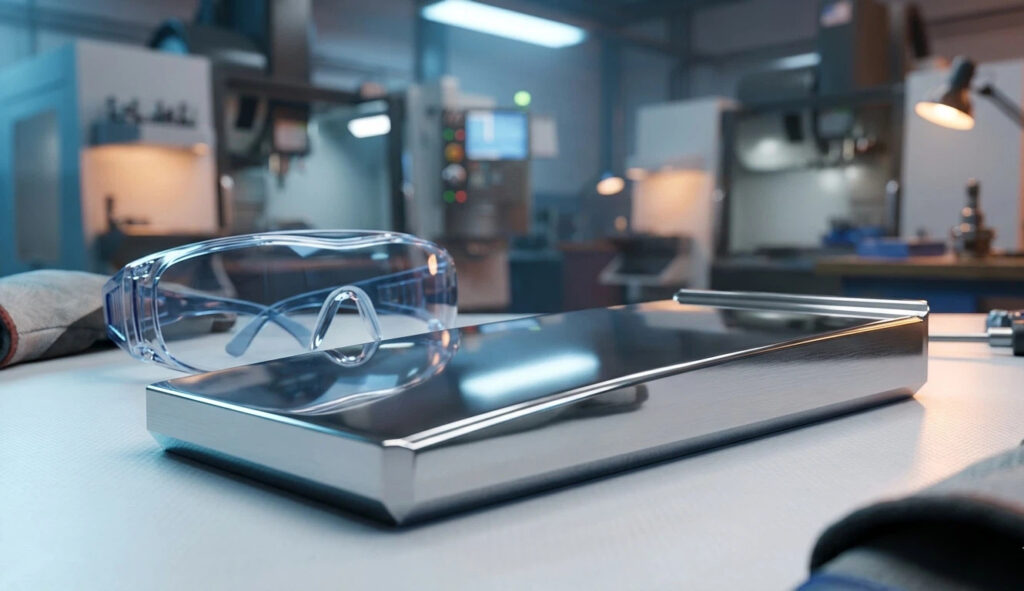
The vacuum degassing process used in NAK80 mold steel solves this by stripping away impurities at the molten stage. This results in a billet with a uniform, ultra-clean microstructure. This cleanliness is the primary reason why it can reach a mirror-like finish that cheaper alternatives simply cannot sustain. For designers of light guides, this purity ensures that every lumen of light travels exactly where the CAD model intended, without being scattered by surface imperfections.
NAK80 vs. S-Star for Light Guides
A common debate in the toolroom is the choice between NAK80 vs S-Star for light guides. Both are premium materials, but they serve different masters. S-Star is a 420-series stainless steel, meaning it offers incredible corrosion resistance. If you are molding PVC or other corrosive resins, S-Star is a strong candidate. However, it comes with a trade-off: heat treatment. S-Star requires a complex quenching and tempering cycle, which inevitably introduces the risk of dimensional distortion and internal stress.
In contrast, choosing NAK80 mold steel means you machine it, you polish it, and you put it in the press. There is no second trip to the vacuum furnace. For complex light guide geometries where optical axis alignment is critical, the lack of heat-treat distortion makes it the safer, faster choice. Furthermore, the thermal conductivity uniformity found in NAK80 mold steel helps in achieving faster cycle times, as the heat is pulled away from the resin more consistently than with stainless grades.
Analyzing NAK55 vs NAK80 Mold Steel for Optical Grades
Many procurement departments see the price difference and wonder if they can substitute NAK55 for NAK80. From a “machinability” standpoint, NAK55 is actually easier to cut because it contains added sulfur. However, in the world of high-gloss finishes, sulfur is your worst enemy.
When analyzing nak55 vs nak80 properties, the choice becomes clear based on the final application. NAK55 is fantastic for structural mold bases or high-production parts where a standard finish is acceptable. But the inherent limitations compared to NAK80 mold steel become obvious during the diamond paste stages. The sulfur that makes NAK55 easy to machine will create “streaking” or “comet tails” that are impossible to buff out. For optical-grade parts, the low-sulfur chemistry is non-negotiable because it is specifically engineered for transparency-critical molding.
Polishing and Machinability
Achieving a flawless surface on this grade requires a shift in mindset. Toolmakers often make the mistake of using too much pressure, thinking it will speed up the process. With pre-hardened steels, excessive pressure generates localized heat. This heat can cause the material to “smear” at the molecular level, leading to the dreaded orange peel effect.
When mastering how to work with NAK80 mold steel, follow the “Cross-Hatch Rule.” Never polish in a circular motion for extended periods. Move from #400 grit to #800 grit by changing your polishing direction by 90 degrees. This allows you to visually confirm that you have removed every single scratch from the previous stage. Because of the consistent 40 HRC of NAK80 mold steel, it responds with a crisp, clear reflection that looks more like glass than metal once you reach the 1-micron paste stage.
Tactical Advice for Preventing Orange Peel on Optical Molds
One of the most frustrating defects is “Orange Peel”—a wavy, uneven texture that appears right as you reach the final mirror stage. This is often caused by over-polishing. When you polish too long in one spot with high pressure, the softer elements of the alloy’s matrix are eroded faster than the harder elements.
Total Cost of Ownership: The Hidden Savings
At first glance, investing in NAK80 mold steel carries a higher upfront cost per kilogram. However, savvy project managers look at the Total Cost of Ownership (TCO). When you factor in the elimination of heat treatment costs, the zero risk of cracked molds in the furnace, and the reduction in manual polishing hours, it often becomes the more economical choice.
Furthermore, the age-hardening standard in NAK80 mold steel allows for laser welding without the massive hardness drop-off seen in other steels. In the fast-paced world of consumer electronics, design changes are inevitable. If you need to move a rib or a boss, this steel can be welded and re-polished without leaving “witness lines” on the final molded part. It is a premium mirror polish steel that supports the entire lifecycle of the mold, from initial prototyping to high-volume production.
conclusion
In the final analysis, the success of your optical project depends on the “purity” of your starting point. You can have the most talented polishing team in the world, but they cannot fix a steel billet that is riddled with micro-impurities. By specifying NAK80 mold steel, you are removing the variables that lead to late-stage failures. You are choosing a material that is pre-hardened for stability, vacuum-degassed for purity, and engineered specifically for the demands of modern optical molding. When your reputation is on the line with a mirror finish, don’t leave the result to chance—choose the steel designed to reflect perfection.
FAQ
Can I use NAK80 for molds producing acidic plastics like PVC?
It is not recommended. While it is superior for polishing, it lacks the chromium content found in S-Star to resist acid corrosion. Use it for PC, PMMA, and ABS.
Does it require any stress relieving after heavy machining?
Yes. If you have removed a large volume of material (roughing) from a block of NAK80 mold steel, a stress-relief at approximately 500°C is recommended to ensure the highest dimensional stability.
What is the best way to ensure long-term maintenance for NAK80 mold steel?
Because it is not a stainless grade, always use a high-quality rust preventative spray when the mold is out of production. Its purity makes it sensitive to oxidation if left unprotected in humid environments.
Why do I see “shadows” on my NAK80 mold steel after chemical etching?
This usually indicates inconsistent polishing before etching. The surface must be uniformly prepared to ensure even acid penetration, allowing the fine grain structure to show through.