
M35 vs M42 Cobalt Drill Bits is not a small grade debate when drilling stainless steel. It is the difference between a tool that keeps cutting and one that turns blue, loses hardness, and starts rubbing before the hole is finished. This guide explains how 5% cobalt and 8% cobalt affect heat resistance, edge life, and real shop-floor choices.
Why stainless steel burns drill bits so quickly
Stainless steel creates trouble because heat stays close to the cutting zone and the surface can work-harden when the drill rubs instead of cuts. A study on work-hardening in drilling austenitic stainless steels examined chip formation at the cutting edge, where stainless drilling becomes unstable when speed, feed, or tool sharpness is wrong.
The pattern is familiar: the drill squeals, chips become dusty, the cutting lip turns blue, and the hole needs more pressure. At that point, the edge may already be softened.
M35 vs M42 Cobalt Drill Bits matters because cobalt high speed steel keeps hardness better under heat. But if the drill is too fast, feeding too lightly, or running dry, even a premium bit can burn.
M35 vs M42 Cobalt Drill Bits: what cobalt high speed steel means
That is the basis of M35 vs M42 Cobalt Drill Bits. You are comparing how long the cutting edge remains hard when stainless steel pushes heat back into the tool.
5% cobalt vs 8% cobalt: what changes in the cut
M35 is commonly understood as the 5% cobalt HSS grade. M42 is commonly treated as the higher cobalt grade, usually around 8%. Griggs Steel describes M42 as a molybdenum high-speed steel with 8% or 10% cobalt and better red hardness than conventional high-speed steels. HSSMetal identifies M35 as a 5% cobalt grade and M42 as an 8% cobalt molybdenum high-speed tool steel.
In real drilling, the difference looks like this:
- M35: good heat resistance, better value, more forgiving in unstable setups.
- M42: higher red hardness, stronger edge retention under heat, better for harder stainless or repeated holes.
- M35: often enough for 304 stainless, thin plates, repair drilling, and lower-volume work.
- M42: better for 316 stainless, thicker sections, production drilling, and high-heat cutting.
M35 vs M42 Cobalt Drill Bits is not “good vs bad.” It is “balanced toughness and cost” vs “higher heat resistance and edge stability.”
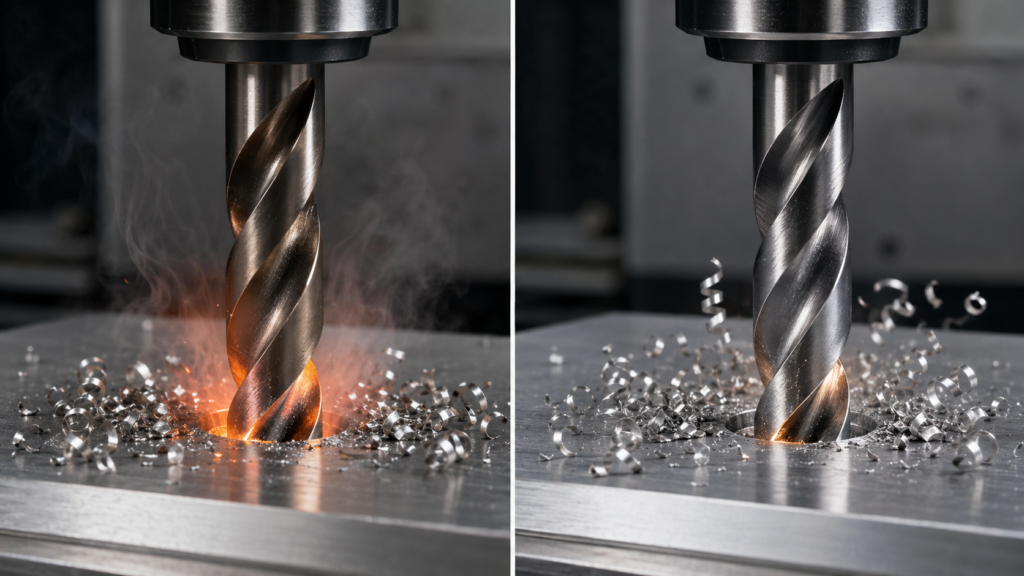
M42 vs M35 for stainless steel drilling
For the long-tail question M42 vs M35 for stainless steel drilling, the answer depends on the failure mode.
If your M35 drill still looks sharp but the cutting edge has turned blue and stopped cutting, heat is probably the main problem. M42 is the logical upgrade because it holds hardness better at elevated temperature.
If your drill breaks, chips, or wanders because the machine lacks rigidity, M42 may not solve the issue. In that case, M35 can be the better practical choice, especially with a hand drill or poorly clamped workpiece.
M35 vs M42 Cobalt Drill Bits also depends on volume. For a few holes in 304 stainless, M35 may be economical. For repeated drilling in 316 stainless or thick plate, M42 often reduces tool changes.
Why drill bits anneal at the cutting edge
Tool edge annealing happens when the cutting lip gets overheated enough to lose part of its hardened condition. Once the edge softens, the drill rubs more, creates more heat, and fails faster.
Common causes include:
1.RPM is too high for the diameter and stainless grade.
2.Feed is too light, so the edge polishes instead of cuts.
3.The drill is dull or poorly sharpened.
4.Chips are packed in the flute.
5.No cutting oil or coolant reaches the point.
6.The operator dwells at the bottom of the hole.
M35 vs M42 Cobalt Drill Bits can improve resistance to this problem, but technique still decides the result.
How to avoid burning drill bits in stainless steel
Start with slower speed and steady feed. Stainless steel does not reward hesitation. The drill needs to bite and form chips.
Use these shop rules:
- Reduce RPM when the drill diameter increases.
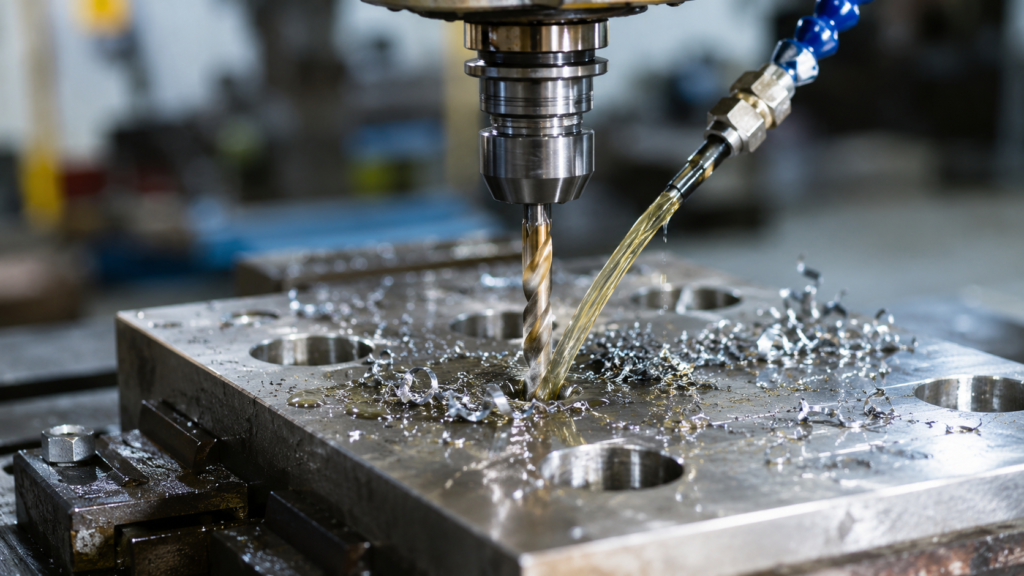
- Apply cutting oil before the edge starts discoloring.
- Feed firmly enough to cut, not rub.
- Back the drill out to clear chips.
- Use a pilot hole for larger holes.
- Clamp the workpiece and reduce vibration.
- Stop using the bit once the lips are rounded.
For the best cobalt drill bit for stainless steel, choose M35 for general use and M42 when heat is the failure point. M35 vs M42 Cobalt Drill Bits should always be paired with correct speed, feed, and coolant practice.
When M35 is the smarter choice
M35 is a strong choice for 304 stainless, thin sheet, maintenance drilling, bracket work, and mixed-material jobs. It gives a useful upgrade over standard HSS without the higher cost of M42.
M35 vs M42 Cobalt Drill Bits often favors M35 when the setup is not perfectly rigid. Hand drilling, interrupted cuts, poor clamping, and side loading can punish a harder tool. If the job is not creating extreme heat, M35 is often the better cost-per-hole option.
When M42 is worth paying for
M42 is the better choice when stainless steel heat is killing the edge before normal wear occurs. Choose it for 316 stainless, thicker plate, production batches, harder alloys, or jobs where changing tools slows the line.
M35 vs M42 Cobalt Drill Bits favors M42 when the problem is edge softening, not tool breakage. For stable machines with coolant, M35 vs M42 Cobalt Drill Bits often becomes a productivity decision.
Final takeaway
M35 vs M42 Cobalt Drill Bits is really a choice between 5% cobalt value and 8% cobalt heat resistance. M35 is the smart choice for general stainless drilling, especially when the setup is less rigid or volume is low. M42 is the better answer when the edge burns, turns blue, or loses hardness before the drill wears out.
For stainless steel, do not choose by cobalt percentage alone. Match the tool to the steel grade, heat level, machine rigidity, coolant, and batch size. That is how M35 vs M42 Cobalt Drill Bits becomes a real solution to burned cutting edges. M35 vs M42 Cobalt Drill Bits should always be judged by the failure mode first.
FAQ
Are M42 drill bits better than M35?
M42 is better for high-heat stainless drilling. M35 is better for general drilling and unstable setups.
Is 8% cobalt always better than 5% cobalt?
No. 8% cobalt improves heat resistance, but 5% cobalt can be more economical and forgiving.
Why do drill bits burn in stainless steel?
They burn because stainless steel traps heat, work-hardens, and punishes rubbing.
What is the best cobalt drill bit for stainless steel?
M35 suits general 304 stainless. M42 is better for 316 stainless, thick plate, and repeated high-heat drilling.
Can cutting oil prevent edge annealing?
It helps, but it must be used with correct speed, firm feed, sharp geometry, and chip clearance.