
In the competitive landscape of modern manufacturing, selecting a material isn’t just about finding the “strongest” metal; it is about matching metallurgical properties to the specific stresses of an industrial environment. Among the most debated pairings in the shop are M2 Steel and D2. Both are titans in the tool steel category, yet they operate on fundamentally different chemical philosophies.
Whether you are engineering high-speed cutting tools or long-run cold-work dies, the choice between these two alloys determines your tool’s lifespan and failure mode. In this guide, we will break down the structural DNA of both materials to help you decide which one aligns with your specific operational requirements.
What is M2 Steel?
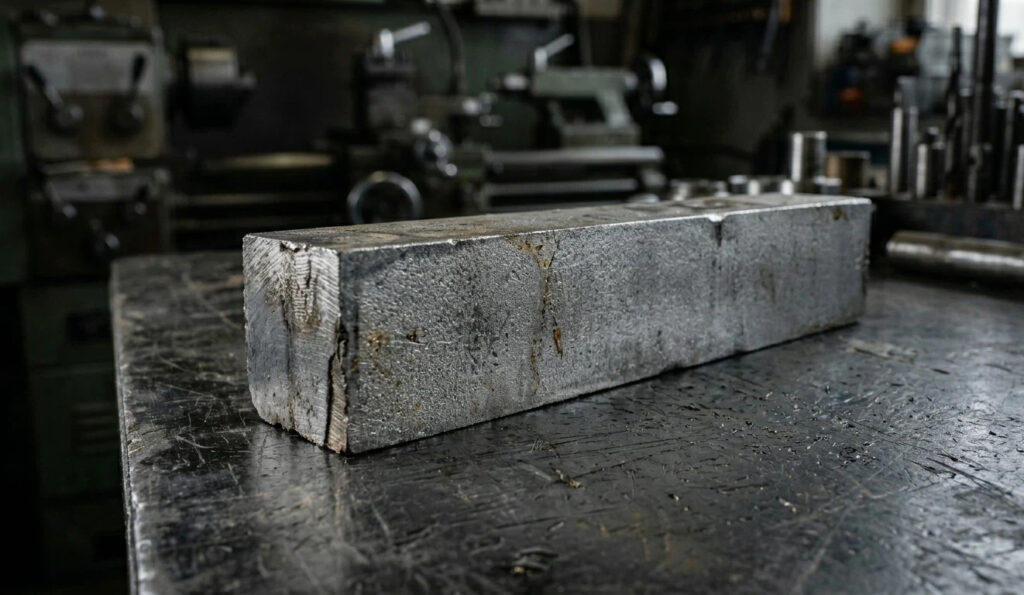
Known as the “industry standard” for high-speed applications, M2 Steel is a molybdenum-based high-speed steel (HSS). It was developed to provide a balanced combination of toughness, wear resistance, and, most importantly, “red hardness.” This refers to the ability of the alloy to maintain its hardness even when M2 Steel is subjected to friction-generated temperatures upwards of 500°C (932°F).
Technically classified as M2 High Speed Steel, this alloy utilizes a fine-grain structure rich in tungsten and molybdenum. This makes it the go-to choice for power-saw blades, drill bits, and taps where heat and speed are constant variables. When you need a tool that won’t soften under rapid cycling, the thermal stability of this grade is indispensable.
What is D2 Steel?
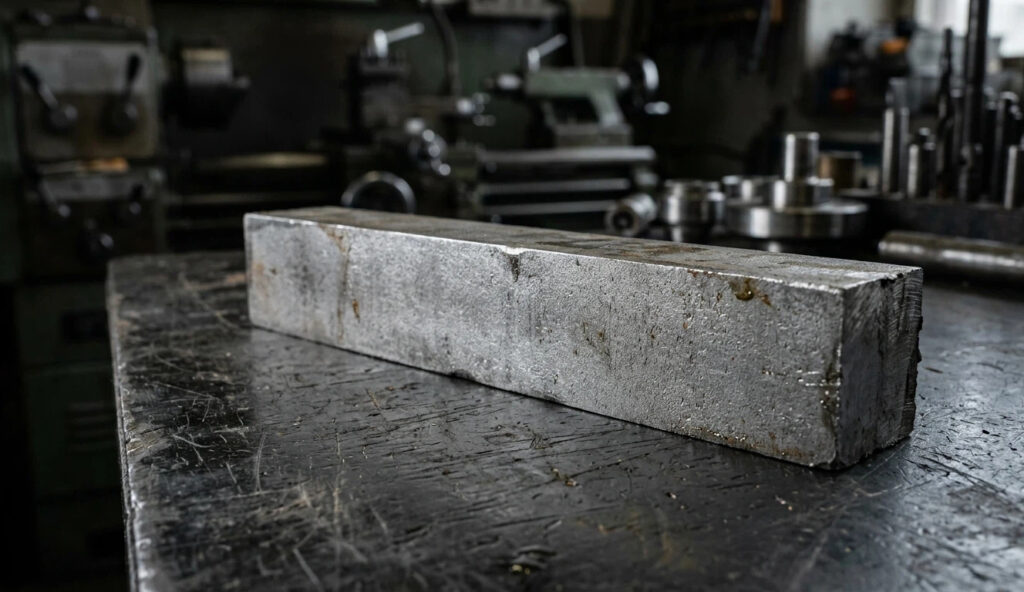
On the other side of the spectrum, D2 Steel is a high-carbon, high-chromium cold-work tool steel. It is often referred to as a “semi-stainless” steel because its chromium content (around 12%) is just below the threshold of true stainless. This material is engineered for maximum abrasive wear resistance.
While it lacks the red hardness of M2 Steel, D2 excels in “cold” environments where the tool must withstand the constant grinding of hard materials. Its large chromium-rich carbides provide a level of surface protection that few other steels can match in a cold-stamping or shearing context.
D2 vs M2 Tool Steel: The Performance Comparison
When analyzing D2 vs M2 tool steel, the first thing an engineer looks at is the carbide distribution. M2 features smaller, more evenly dispersed carbides. This uniformity is why M2 Steel often exhibits better structural integrity under shock. In contrast, D2 contains larger primary carbides which, while excellent for sliding wear, can act as stress risers.
The debate of D2 vs M2 tool steel often centers on whether your application involves “heat” or “abrasion.” If your tool is moving fast and getting hot, the HSS properties of the molybdenum-based alloy are necessary. If the tool is working at room temperature on abrasive stock, the chromium-heavy profile of D2 may provide a more cost-effective service life.
It is also worth noting that D2 vs M2 tool steel choices often come down to the specific geometry of the tool. For thin, intricate edges that are prone to chipping, the finer grain of the HSS grade is usually preferred.
Rockwell Hardness (HRC) and Red Hardness
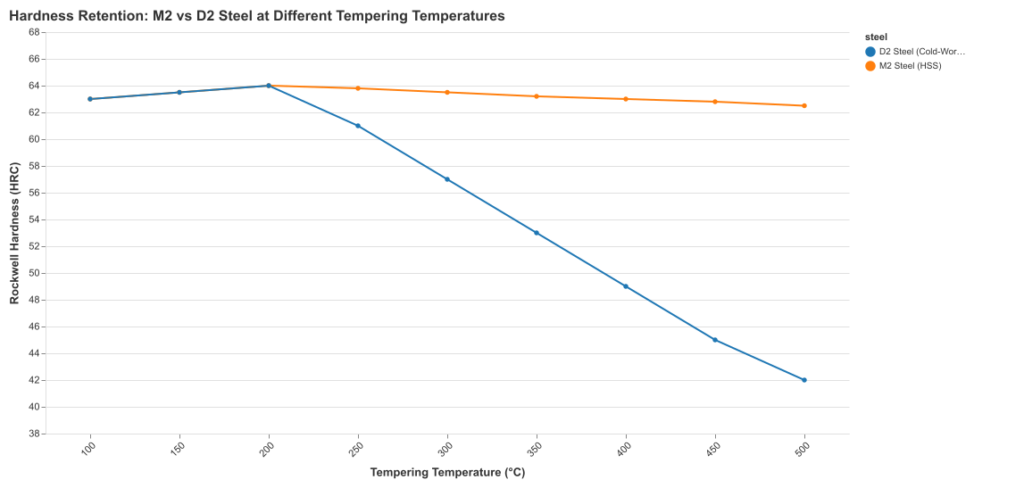
Both materials can reach a similar Rockwell Hardness (HRC), typically ranging between 60 and 64 HRC depending on the temper. However, the quality of that hardness differs. M2 Steel achieves its peak hardness through a process called secondary hardening, where alloying elements like vanadium form stable carbides during tempering.
If you push D2 past 200°C, its Rockwell Hardness (HRC) begins to drop significantly. The HSS grade, however, stays rigid. According to the ASM International Specialty Handbook, M-series steels are specifically designed to resist the softening effect of high-temperature service, a trait that cold-work steels simply do not possess.
Wear Resistance and Toughness: Finding the Balance
The relationship between wear resistance and toughness is usually an inverse one. Generally, D2 offers superior abrasive wear resistance due to its massive chromium carbides. However, this comes at the cost of toughness. If you are asking, “Is M2 steel better than D2 for impact tools?”, the answer is generally yes.
The finer grain structure of the HSS alloy allows it to absorb energy without fracturing as easily as D2. This makes it more reliable for tools that experience “interrupted cuts” or sudden shocks. To bridge this gap, many shops are turning to powder metallurgy steel. Processes like CPM (Crucible Particle Metallurgy) result in CPM D2 benefits such as a much finer carbide distribution, allowing the material to mimic some of the toughness found in M2 Steel.
When we evaluate D2 vs M2 tool steel in terms of failure modes, D2 tends to fail via chipping or “macro-fracture,” whereas the molybdenum grade is more likely to wear down gradually through “micro-abrasion.”
Technical Comparison Matrix
| Property | M2 (High Speed) | D2 (Cold Work) |
| Primary Alloy | Tungsten-Molybdenum | High Carbon-Chromium |
| Red Hardness | Excellent (up to 540°C) | Poor (Softens above 200°C) |
| Wear Resistance | High | Very High (Abrasive) |
| Toughness | Moderate-High | Moderate-Low |
| Machinability | Good for HSS | Fair (Gummy) |
| Corrosion Resistance | Low | Moderate (Semi-Stainless) |
Machinability and Processing
For the shop floor, the machinability comparison of D2 and M2 steel is a vital factor in project timelines. M2 is generally considered easier to machine in its annealed state than D2. D2 is notoriously “gummy” and tough on cutters because of its high chromium content.
When it comes to grinding after heat treatment, M2 Steel also holds a slight edge in terms of surface finish quality, although both require specialized ceramic or CBN wheels. If your project requires complex EDM (Electrical Discharge Machining), D2 is often preferred due to its dimensional stability, though both require careful stress-relieving post-EDM.
In the context of D2 vs M2 tool steel manufacturing costs, the faster cutting speeds allowed when machining the HSS grade can often offset its higher raw material price.
The Heat Treatment Path
The M2 steel heat treatment process is significantly more complex than that of D2. M2 requires a multi-stage preheating cycle to prevent thermal shock, followed by quenching from a very high temperature (near 1200°C). It then requires at least two, and often three, tempering cycles to transform the retained austenite into tempered martensite.
D2 is more forgiving, usually quenched from a lower temperature (around 1010°C). While D2 is easier for smaller shops to heat treat, the sophisticated secondary hardening of M2 Steel is what gives it the “edge” in professional high-speed environments.
Knife Making: D2 vs M2 Steel for Knife Making
In the custom knife community, the D2 vs M2 steel for knife making debate is legendary. D2 is a favorite for hunting knives because it holds an edge for an incredibly long time and offers decent stain resistance. However, it can be difficult for a user to re-sharpen in the field due to those hard chromium carbides.
A knife made of M2 Steel will stay sharp even if the user is cutting through materials that generate heat, such as high-speed rope cutting or heavy wood processing. It takes a very fine edge and is highly prized in wood-turning tools and heavy-duty fixed blades, despite its tendency to patina or rust if not oiled.
Which One Fits Your Workflow?
Ultimately, your choice depends on the environment. If your application involves high-speed friction, heat, and a need for toughness against shattering, you should tend toward M2 Steel. Its red hardness and refined grain structure are designed for the stresses of motion.
However, if you are looking for a cost-effective solution for cold-stamping or a knife that needs to resist abrasive wear at room temperature, D2 remains a formidable option. While D2 Steel remains the titan of cold-work, M2 Steel takes the lead whenever temperature and shock enter the equation. When navigating D2 vs M2 tool steel decisions, always prioritize the thermal environment—that is the “smoking gun” that dictates your material’s success.
FAQ
Is M2 steel better than D2 for impact tools?
Generally, yes. The finer grain structure of M2 handles shock and vibration better than the larger, more brittle carbides found in standard D2.
Which steel is easier to sharpen at home?
M2 is typically easier to sharpen than D2 because its carbides are smaller, allowing for a finer, more uniform edge apex without “tearing” the steel.
Does D2 rust easier than M2?
No. D2 has a much higher chromium content, making it much more resistant to corrosion and oxidation than the HSS grade.
Can CPM D2 bridge the gap?
Absolutely. CPM D2 benefits include vastly improved toughness, making it much more competitive with M2 in impact-heavy applications.