
In the precision-driven world of tool and die manufacturing, selecting the right material is not just a preference—it is a requirement for tool longevity. For many global procurement managers, identifying a reliable H13 steel equivalent is a daily challenge, especially when navigating the subtle differences between American and European standards.
When your design blueprint calls for H13 but your regional supplier stocks 1.2344, the immediate question arises: AISI H13 vs. DIN 1.2344: Are they truly interchangeable? While they are often grouped together in standard cross-reference tables, the reality is more nuanced.
Why H13 Steel Equivalent is the Industry Gold Standard
H13 is arguably the most versatile hot work tool steel in use today. Its high chromium content provides excellent resistance to thermal fatigue and “heat checking,” which is essential for components exposed to extreme temperature cycles. Because of its global popularity, finding an H13 steel equivalent like the German 1.2344 (W-Nr 1.2344) or the Japanese SKS61 is common practice.
However, a “functional equivalent” does not always mean a “chemical twin.” Engineers must understand the specific H13 steel properties that define performance under stress before authorizing a material substitution.
AISI H13 vs. DIN 1.2344: Decoding the Standards
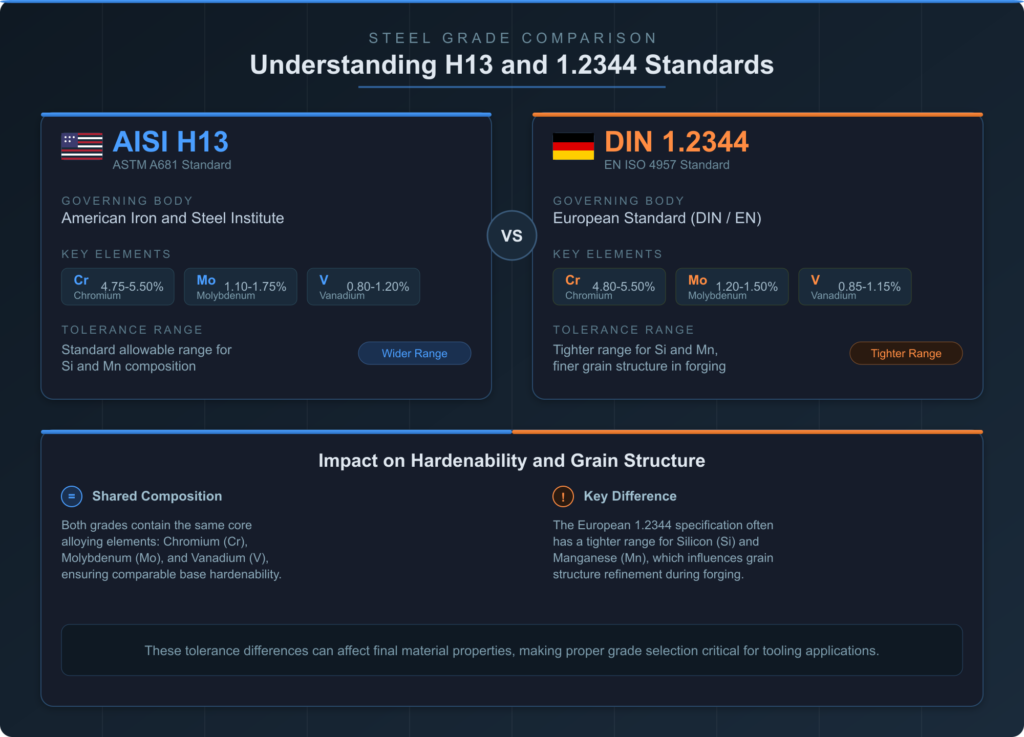
The primary difference between these two grades lies in the regulatory bodies that govern them. AISI H13 is managed by the American Iron and Steel Institute (ASTM A681), while DIN 1.2344 is a German standard under the EN ISO 4957 framework.
When searching for an H13 steel equivalent, you will notice that both contain Chromium (Cr), Molybdenum (Mo), and Vanadium (V). Yet, the allowable tolerances for these elements can impact the steel’s hardenability. For instance, the European version (1.2344) often has a slightly tighter range for Silicon and Manganese, which can influence the grain structure during forging.
Chemical Composition Comparison Table
To help you visualize the differences in an H13 steel equivalent, let’s look at the standard chemical analysis of AISI H13 vs. DIN 1.2344.
| Element | AISI H13 (%) | DIN 1.2344 (X40CrMoV5-1) (%) | Difference Impact |
| Carbon (C) | 0.32 – 0.45 | 0.37 – 0.43 | Stability |
| Chromium (Cr) | 4.75 – 5.50 | 4.80 – 5.20 | Oxidation resistance |
| Molybdenum (Mo) | 1.10 – 1.75 | 1.20 – 1.50 | Red hardness |
| Vanadium (V) | 0.80 – 1.20 | 0.90 – 1.10 | Wear resistance |
| Silicon (Si) | 0.80 – 1.25 | 0.90 – 1.20 | Tempering stability |
Understanding H13 Steel Properties in Die Casting
For those in the automotive sector, H13 is the quintessential die casting mold steel. It must withstand the high-velocity impact of molten aluminum or zinc without cracking. When you select 1.2344 as an H13 steel equivalent, you are typically looking for superior toughness.
In many high-end applications, the impact toughness comparison of H13 and 1.2344 shows that the European grade, particularly when processed via Electroslag Remelting (ESR), offers a cleaner microstructure. This purity is vital for preventing premature failure in complex die geometries.
The ESR Factor: Elevating the H13 Steel Equivalent
If your project requires the highest reliability, simply asking for an H13 steel equivalent is not enough. You should specify the melting process. ESR (Electroslag Remelting) H13 or 1.2344 significantly reduces non-metallic inclusions. This leads to:
1.Improved polishability for high-gloss molds.
2.Better transverse mechanical properties.
3.Higher resistance to thermal fatigue.
For premium projects, compliance with the NADCA 207 standard for H13 steel is the benchmark for quality. This standard, established by the North American Die Casting Association, classifies H13 into different quality grades (Premium, Superior) based on microstructure and impact strength.
Heat Treatment of H13 Steel and Its Equivalents
Proper heat treatment of H13 steel is where the actual performance is forged. Both H13 and its German H13 steel equivalent respond well to vacuum quenching and tempering.
- Preheating: Usually done in two stages (650°C and 850°C) to minimize distortion.
- Austenitizing: Heating to 1020-1050°C.
- Tempering: At least two tempers are required, with the final hardness usually falling between 46-52 HRC for most die-casting tools.
Is 1.2344 identical during this process? Yes, the thermal expansion and transformation temperatures are close enough that a standard H13 heat treatment cycle is usually applicable to a 1.2344 H13 steel equivalent.
Is H13 Interchangeable with 1.2344?
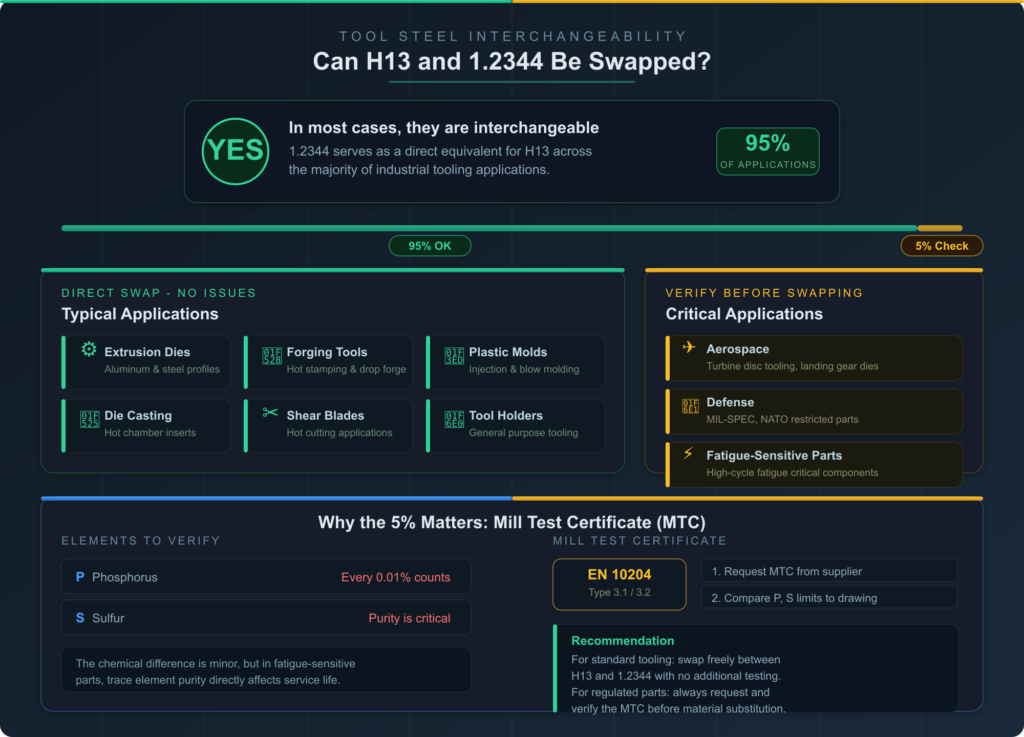
The short answer is yes. In 95% of industrial applications—including extrusion dies, forging tools, and plastic molds—1.2344 serves as a perfect H13 steel equivalent.
However, in the remaining 5%, such as highly regulated aerospace or defense contracts, you must verify the specific “Mill Certificate” (MTC) to ensure the Phosphorus and Sulfur levels meet the drawing’s exact requirements. The chemical composition difference between H13 and 1.2344 is minor, but in critical fatigue-sensitive parts, every 0.01% of purity counts.
Sourcing Tips for H13 Steel Equivalent Billets
When procuring these materials, don’t just look for the lowest price per kg. Consider the “Total Cost of Tooling.” A cheaper, non-standard H13 steel equivalent might save money upfront but lead to “heat checking” after only 10,000 cycles.
1.Check Certification: Ensure the material meets ISO 4957 or ASTM A681.
2.Verify Hardness: Confirm the delivery state (Annealed, usually <235 HB).
3.Inspect Surface: Look for decarb-free surfaces if buying pre-machined plates.
Conclusion
Selecting an H13 steel equivalent like 1.2344 is a safe and effective strategy for global manufacturing. By understanding the core H13 steel properties and adhering to standards like NADCA 207, you can ensure that your tooling remains durable, precise, and cost-effective. Whether you call it H13 or 1.2344, the key lies in the quality of the melting and the precision of the heat treatment.
FAQ
What is the main difference in AISI H13 vs. DIN 1.2344?
They are essentially the same material under different regional standards (USA vs. Germany). 1.2344 often features stricter control over minor impurities in premium versions.
Can I use H13 for plastic injection molds?
Yes. While it is a hot work steel, its excellent polishability and toughness make it an ideal H13 steel equivalent for high-volume plastic molds.
What is the recommended hardness for H13 die casting dies?
Typically between 46-50 HRC. Higher hardness increases wear resistance but raises the risk of brittle cracking.
Does “H13 steel equivalent” include SKS61?
Yes, SKS61 is the Japanese (JIS) equivalent and is widely used across Asian manufacturing hubs.