
In a globalized supply chain, a tool designed in Germany using DIN standards may need to be fabricated in Asia using JIS or GB alternatives. Finding the right Cold Work Tool Steel Equivalents is not merely about finding a “similar” name; it is about matching the chemical composition and heat treatment response to ensure the tool’s longevity. If a substitution is made without verifying the precise metallurgical profile, the risk of premature cracking or excessive wear increases exponentially.
Cold work steels are characterized by their high hardness, excellent wear resistance, and good toughness. These materials operate at surface temperatures typically below 200°C. However, the designation system varies significantly between global steel standards. While the American AISI system uses alphanumeric codes (e.g., D2, O1), the European DIN system relies on material numbers (e.g., 1.2379) or chemical symbols (e.g., X153CrMoV12). Understanding how these systems interact is the first step in mastering Cold Work Tool Steel Equivalents.
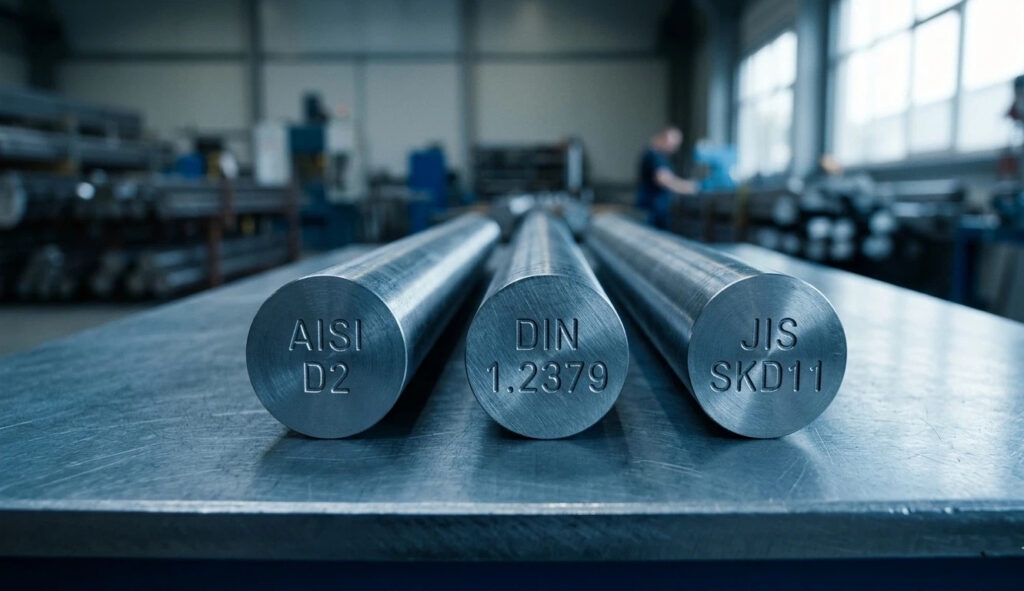
Table of Contents
Master Tool Steel Comparison Chart
To streamline your procurement and design phase, the following table provides a high-level tool steel comparison chart for the most frequently specified Cold Work Tool Steel Equivalents. This cross-reference allows for a quick AISI to DIN cross reference and identifies Chinese GB and Japanese JIS alternatives that are functionally interchangeable in most industrial applications.
| AISI (USA) | DIN / En (Germany/EU) | JIS (Japan) | GB (China) | Primary Characteristics |
| D2 | 1.2379 / X153CrMoV12 | SKD11 | Cr12Mo1V1 | High carbon, high chrome; superior wear resistance. |
| D3 | 1.2436 / X210CrW12 | SKD1 | Cr12W | Excellent abrasion resistance; used for blanking dies. |
| O1 | 1.2510 / 100MnCrW4 | SKS3 | 9CrWMn | Oil-hardening; excellent dimensional stability. |
| A2 | 1.2363 / X100CrMoV5 | SKD12 | Cr5Mo1V | Air-hardening; balance of toughness and wear resistance. |
| D5 | 1.2601 | SKD11 (mod) | Cr12MoV | Cobalt-added for higher hot-hardness. |
| S7 | 1.2355 / 50CrV4 (approx) | – | – | Shock-resisting; high impact toughness. |
Metallurgical Nuances in Equivalent Selection
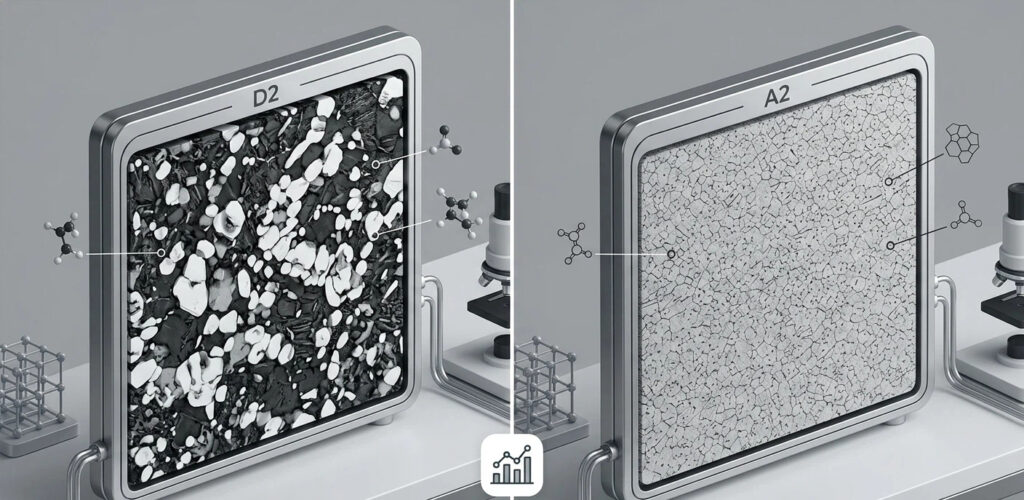
When evaluating Cold Work Tool Steel Equivalents, engineers must understand that “equivalent” does not always mean “identical.” For example, the D2 vs 1.2379 performance comparison reveals that while they are functionally interchangeable, slight variations in Manganese (Mn) or Vanadium (V) levels can alter the depth of hardening. A “near-match” in chemistry can result in different carbide distributions, which directly impacts the tool’s performance under heavy load.
The impact of trace elements on Cold Work Tool Steel Equivalents cannot be overstated. Global steel standards differ in their tolerance levels for sulfur and phosphorus. A JIS steel grade equivalent table might suggest SKD11 as a match for D2, but the Japanese standard often specifies tighter controls on Phosphorus (P) and Sulfur (S), which can lead to better polishability and fatigue life in high-precision molds compared to standard commercial-grade D2.
Hardness vs. Toughness Trade-off
Choosing cold work tool steel based on hardness requirements is the most common starting point. High-carbon grades like D2 can achieve 60-62 HRC, providing exceptional resistance to abrasive wear. However, for applications involving heavy shock or impact—such as cold heading or heavy-duty punching—shifting to an AISI to DIN cross reference for S7 or A2 might be necessary to prevent catastrophic tool failure.
Economic Impact of Steel Equivalency
The financial impact of Cold Work Tool Steel Equivalents on project costs is significant. In many cases, a regional equivalent is 20-30% more cost-effective than importing a specific brand-name steel. For instance, using a high-quality GB Cr12Mo1V1 instead of imported AISI D2 can drastically reduce the “Total Landed Cost” without sacrificing tool performance, provided the heat treatment protocol is adjusted to the specific melt chemistry. This strategic approach to sourcing is a hallmark of modern, efficient procurement.
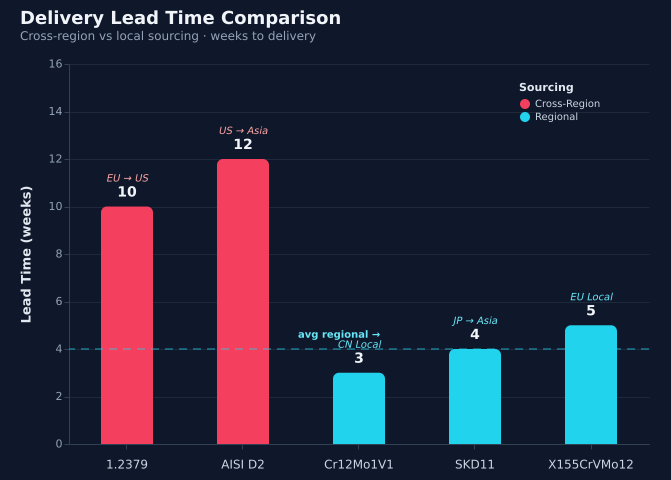
When calculating the ROI of different Cold Work Tool Steel Equivalents, one must also consider lead times. Sourcing a JIS SKD11 locally in Asia is often faster than waiting for a European 1.2379 shipment. Furthermore, understanding European steel standards vs ASTM allows for a broader supplier base. If a project in the EU specifies 1.2379, a US-based manufacturer can confidently document the Cold Work Tool Steel Equivalents for the end client’s quality assurance team by providing the relevant ASTM A681 D2 data sheets.
The Selection Protocol for Global Projects
To successfully implement Cold Work Tool Steel Equivalents, follow this three-step protocol designed for high-stakes engineering environments:
1.Analyze the Stress Profile: Determine if the primary failure mode is wear, chipping, or deformation.
2.Verify Chemical Interoperability: Use a tool steel comparison chart to ensure the alloying elements (Cr, Mo, V) are within the tight tolerances required for the intended application.
3.Validate Heat Treatment: Always request a TTT (Time-Temperature-Transformation) curve for the specific regional grade to optimize the quenching and tempering cycles for your chosen Cold Work Tool Steel Equivalents.
Advanced Standards: Beyond the Basics
While AISI and DIN dominate the conversation, the emergence of high-performance proprietary grades (like DC53 or Caldie) has complicated the landscape of Cold Work Tool Steel Equivalents. These steels often bridge the gap between standards, offering toughness that exceeds A2 while maintaining the hardness of D2. When these are specified, finding a direct equivalent in the JIS steel grade equivalent table requires looking at specialized “matrix high-speed steels.”
The shift toward global steel standards harmonization is ongoing, but for now, the burden of verification remains with the engineer. Utilizing a reliable Cold Work Tool Steel Equivalents database is the only way to mitigate the risks of premature tool wear and production downtime. By verifying the grain structure and carbide distribution of your selected material, you ensure that your global manufacturing project remains on schedule and within budget.
Conclusion
In conclusion, the ability to identify and verify Cold Work Tool Steel Equivalents is a vital skill in the modern industrial landscape. Whether you are translating a German blueprint for a Chinese factory or seeking more cost-effective alternatives for a domestic project, the metallurgical fundamentals remain the same. By prioritizing chemical accuracy and documented performance data, you can leverage Cold Work Tool Steel Equivalents to build more durable tools and a more resilient supply chain.
FAQ
Can I always substitute SKD11 for AISI D2?
Generally, yes. They are the most common Cold Work Tool Steel Equivalents. However, always check the Vanadium content if the tool requires extreme abrasion resistance.
Why does the European DIN standard use numbers like 1.2379?
The W-Nr (Werkstoffnummer) system is a structured numerical system. 1.XXXX denotes the material group (1 = Steel), followed by a 4-digit sequence defining the specific alloy.
Is there an equivalent for S7 steel in the Chinese GB standard?
There is no direct “perfect” equivalent in the standard GB catalog, though certain modified 5Cr or 4Cr grades are often used for similar shock-resisting applications.
How does equivalency impact the warranty of my tools?
Unauthorized substitutions can void warranties. Always provide a tool steel comparison chart to your client for approval before substituting Cold Work Tool Steel Equivalents.