
A2 vs S7 steel is not just a hardness comparison. For concrete breakers, stamps, chisels, and thick plate punching tools, the real question is whether the steel can survive repeated shock without cracking, chipping, or breaking too early.
This guide explains when A2 makes sense, when S7 becomes the safer choice, and why impact failure often starts when buyers choose steel by hardness instead of toughness.
Why A2 vs S7 Steel Matters When Impact Tools Keep Breaking
Many tools do not fail slowly. They fail suddenly.
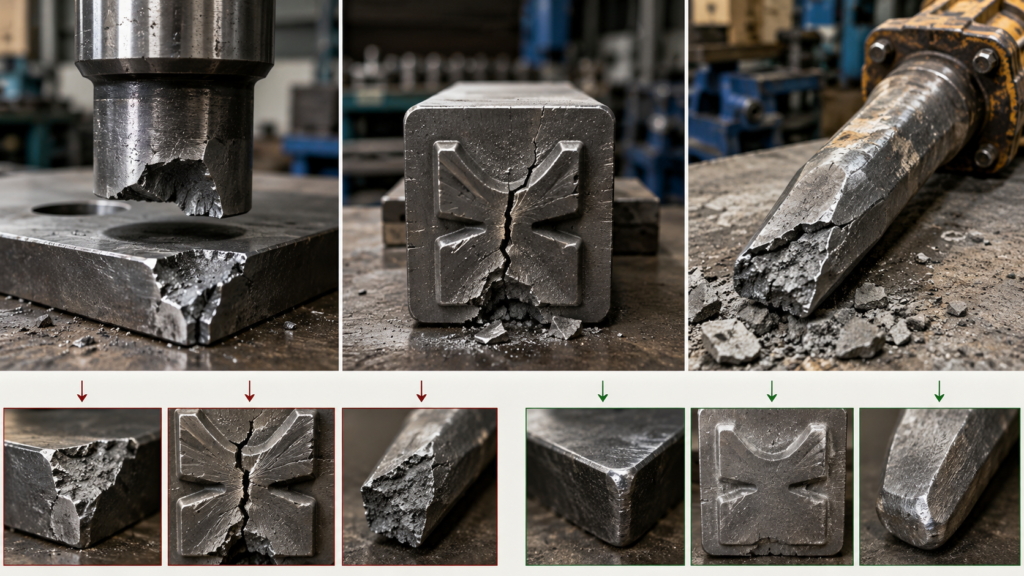
A punch corner chips. A stamp face cracks. A breaker tip snaps under repeated blows. In thick plate punching and demolition-style impact work, that kind of failure is often more dangerous than simple wear.
That is why A2 vs S7 steel matters for buyers who deal with catastrophic tool breakage. A tool that is only hard may hold an edge, but if it cannot absorb impact, it may fracture before normal wear becomes the main issue.
Wikipedia’s overview of tool steel explains that tool steels are selected for properties such as hardness, abrasion resistance, deformation resistance, and performance in shaping other materials. It also notes that shock-resisting group tool steels are designed to resist shock and have very high impact toughness.
A2 Tool Steel: Wear Resistance and Stability Come First
A2 is an air-hardening cold work tool steel. It is often selected when a tool needs wear resistance, decent toughness, good dimensional stability, and predictable heat-treatment behavior.
MatWeb describes AISI Type A2 tool steel as having high hardenability, good wear resistance, fatigue life, toughness, and dimensional stability in heat treatment.
This makes A2 useful for many cold work tools, including forming tools, trimming dies, punches, and wear-focused tooling. In an A2 vs S7 steel decision, A2 should not be treated as a weak option. It is a practical grade when the main failure mode is controlled wear rather than heavy impact.
The limitation appears when shock becomes the main problem. If a tool is breaking before it wears out, A2 may not offer enough impact toughness for the job.
S7 Shock Resisting Tool Steel: Built for Impact Loads
S7 is a shock resisting tool steel. Its strength is not just hardness. Its real value is toughness under impact.
Hudson Tool Steel describes S7 shock-resisting tool steel as an air or oil hardening grade characterized by very high impact toughness, with a combination of strength and high toughness for tooling applications.
That is why S7 is often used for chisels, punches, stamps, concrete breaker tools, and other heavy-impact applications. In A2 vs S7 steel selection, S7 is usually the better direction when sudden cracking or impact breakage is the main cost.
AZoM’s article on shock-resisting tool steels also explains that S-group steels are designated as shock-resisting grades under the AISI classification system, including S7.
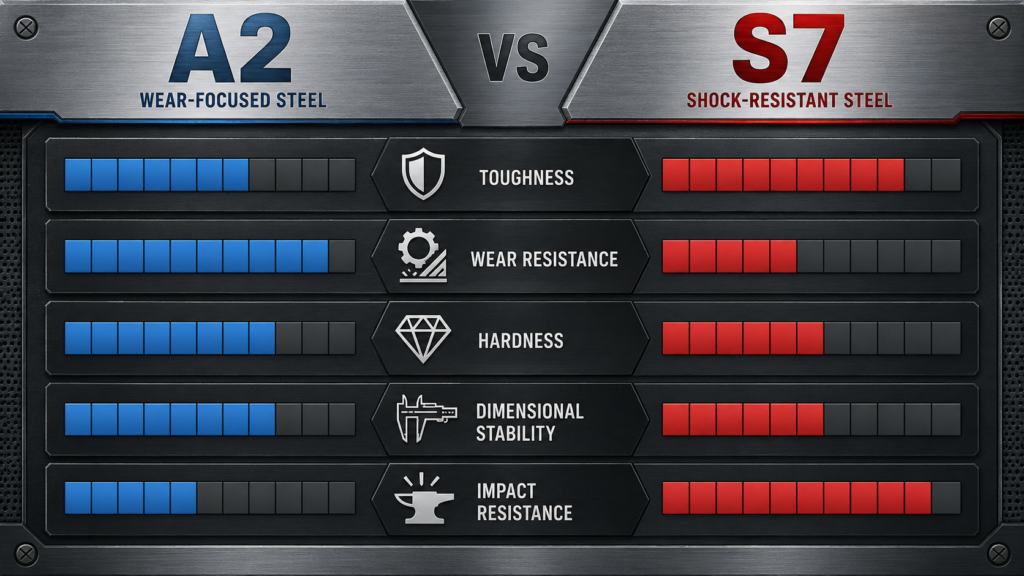
A2 vs S7 Steel Toughness, Wear Resistance, and Hardness Comparison
The most useful way to compare A2 and S7 is by failure mode.
| Factor | A2 Steel | S7 Steel |
|---|---|---|
| Main advantage | Wear resistance and dimensional stability | Shock resistance and toughness |
| Impact resistance | Moderate | High |
| Wear resistance | Better | Good, but usually lower than A2 |
| Best fit | Wear-focused cold work tools | Heavy-impact tools |
| Failure risk | Chipping under severe shock | Better resistance to cracking and breakage |
| Typical use | Dies, punches, forming tools | Chisels, stamps, concrete breakers, impact punches |
Paulo’s technical article on S7, D2, and A2 tool steel properties explains that S7 has excellent impact and shock resistance but is comparatively less wear resistant, while A2 is commonly valued for dimensional stability and balanced performance.
This is the heart of A2 vs S7 steel: choose A2 when wear and stability matter more, and choose S7 when impact toughness is the priority.
Steel for Concrete Breakers and Stamps: Why S7 Often Wins
Concrete breakers, stamps, chisels, and impact punches do not work like ordinary cutting tools. They face repeated shock, vibration, and stress concentration.
For steel for concrete breakers and stamps, toughness can matter more than maximum hardness. A hard but brittle tool may crack at the tip, edge, or shoulder. Once that crack starts, repeated impact can grow it quickly.
In A2 vs S7 steel selection for breaker tools, S7 often makes more sense because the tool is judged by survival under shock, not only by wear life.
Thick Plate Punching: When Breakage Means the Steel Is Too Brittle
Thick plate punching creates high compressive force, edge stress, and impact at the punch tip. If the punch steel is too brittle, the result may be corner breakage, edge chipping, or sudden punch failure.
A2 can work well for many punches. But if the punch breaks before it wears, the application may need shock resistant steel for punches.
This is where A2 vs S7 steel becomes a practical decision. If the tool is wearing gradually, A2 may still be correct. If the tool is cracking, S7 deserves serious evaluation.
A useful rule is simple: wear problems point toward wear-resistant steel; breakage problems point toward tougher steel.
Heat Treatment Can Decide Whether Either Steel Works
The steel name alone does not guarantee tool life.
Heat treatment controls hardness, toughness, residual stress, and dimensional stability. If a tool is hardened too aggressively, it may become brittle. If tempering is not suitable, it may crack under repeated load.
Carpenter Technology’s CarTech S7 datasheet describes S7 as an air-hardening tool steel with high impact and shock resistance, while also giving its chemical composition and heat-treatment context.
For both A2 and S7, the goal is not simply “as hard as possible.” The goal is the correct balance of hardness and toughness for the working condition.
In A2 vs S7 steel projects, ask the heat treater about target hardness, tempering practice, section size, grinding burn, and stress relief. Those details often decide whether the tool survives.
When A2 Is Still the Better Choice
S7 is not automatically better for every tool.
A2 is still a strong choice when the job is dominated by wear, forming accuracy, dimensional stability, and moderate impact. If the tool is not cracking or breaking, switching to S7 may reduce wear resistance without solving a real problem.
Choose A2 when:
- wear is the main failure mode;
- the tool needs good dimensional stability;
- impact is moderate;
- the tool cuts, shears, or forms more than it strikes;
- predictable cold work performance matters.
In A2 vs S7 steel decisions, the better grade is the one that matches the failure mode.
How to Choose Between A2 and S7 for Your Tooling Project
Choose S7 when the tool is exposed to repeated shock, heavy impact, edge cracking, chipping, or sudden breakage.
Choose A2 when the tool mainly needs wear resistance, dimensional control, and stable cold work performance.
A practical selection checklist:
1.Look at the failed tool. Is it worn, chipped, cracked, or broken?
2.Check the working load. Is the tool cutting, punching, striking, or breaking concrete?
3.Review the hardness target. Is it too high for an impact application?
4.Review heat treatment and grinding history.
5.Compare total cost. A cheaper steel is not cheaper if it causes downtime.
That is the best way to handle A2 vs S7 steel selection without guessing.
Conclusion
A2 vs S7 steel should be decided by how the tool fails.
If the tool wears slowly and needs dimensional stability, A2 is often the better fit. If the tool cracks, chips, or breaks under impact, S7 shock resisting tool steel is usually the safer option.
For concrete breakers, stamps, chisels, thick plate punches, and other heavy-impact tools, toughness can matter more than maximum hardness. When downtime and sudden failure are expensive, choosing the right steel is not just a material decision. It is a production risk decision.
FAQ
What is the main difference between A2 and S7 steel?
A2 focuses more on wear resistance and dimensional stability. S7 focuses more on shock resistance and impact toughness.
Is S7 tougher than A2?
Yes. S7 is generally tougher and better for tools exposed to repeated shock or sudden impact.
Is A2 good for punches?
Yes. A2 can work well for many punches, especially when wear is the main problem. For thick plate punching or impact cracking, S7 may be better.
Which steel is better for concrete breakers?
S7 is usually better because concrete breakers need high shock resistance and resistance to sudden breakage.
Does higher hardness always mean better tool life?
No. Higher hardness can improve wear resistance, but too much hardness can reduce toughness and increase cracking risk.
Can S7 be used for stamps?
Yes. S7 is often suitable for impact stamps and marking tools that must resist chipping, cracking, and repeated shock.