
D2 vs D3 tool steel matters when a die, cutter, mold, or wear plate fails by slow abrasive damage instead of one sudden overload. The real cost is not just steel price. It is edge rounding, repeated grinding, lost tolerance, shorter production runs, and unexpected tool replacement.
This guide compares D2 vs D3 tool steel for extreme wear. You will learn why D3 can last longer in the right wear mode, why D2 is still safer in many tools, and how D3 steel equivalent and wear life should be judged before sourcing.
D2 vs D3 Tool Steel Is Not Just a Hardness QuestionD2
Many buyers start with HRC, but D2 vs D3 tool steel is not solved by hardness alone. Two steels can reach similar working hardness and still behave differently in service.
Ask one question first: how does the tool fail?
If the tool slowly wears, loses edge shape, and needs frequent polishing, D3 may be worth testing. If the tool chips, cracks, or breaks at a thin edge, D2 is usually safer.
AZoM’s article on D2 tool steel places D2 in the high-carbon, high-chromium cold-work steel group with D3, D4, D5, and D7. These grades are designed for wear resistance, but they do not share the same toughness and heat-treatment behavior.
What D2 Tool Steel Does Well
D2 is a high carbon chromium steel used in blanking dies, forming dies, punches, thread rolling dies, shear blades, and long-run cold work tools. It gives a useful balance: strong wear resistance, good compressive strength, acceptable toughness, and relatively stable heat treatment.
That balance explains why D2 vs D3 tool steel often favors D2 in general tooling. D2 is not weak. It is simply less specialized than D3.
A MDPI study on AISI D2 and O1 cold work tool steels shows that alloying differences affect microstructure and fracture behavior. For tooling, the grade name is only the starting point.
Why Some Buyers Avoid D2 Tool Steel
Some people dislike D2 because it can be difficult to machine after hardening, slow to sharpen, and vulnerable to chipping if the edge is too thin or the tool sees impact.
That does not make D2 a poor steel. It means D2 needs the right geometry, proper heat treatment, and a suitable failure mode.
Knife Steel Nerds’ article on knife steels rated by a metallurgist shows why users compare toughness, edge retention, and corrosion resistance instead of judging by one number. For industrial tools, D2 vs D3 tool steel should not be decided by online opinions.
What Makes D3 Tool Steel Different
D3 is also a high carbon chromium steel, but it is more wear-focused. AZoM’s D3 tool steel article describes D3 as a high-carbon, high-chromium cold-work steel and notes that D3 requires hardening and tempering for maximum properties.
D3 usually has higher carbon and more hard carbides. These carbides resist abrasive cutting and help the working surface hold shape longer. The trade-off is lower toughness and higher risk under shock loading.
This is the core of D2 vs D3 tool steel: D3 can be excellent when wear is the enemy, but it is not the best choice when the tool fails by fracture.
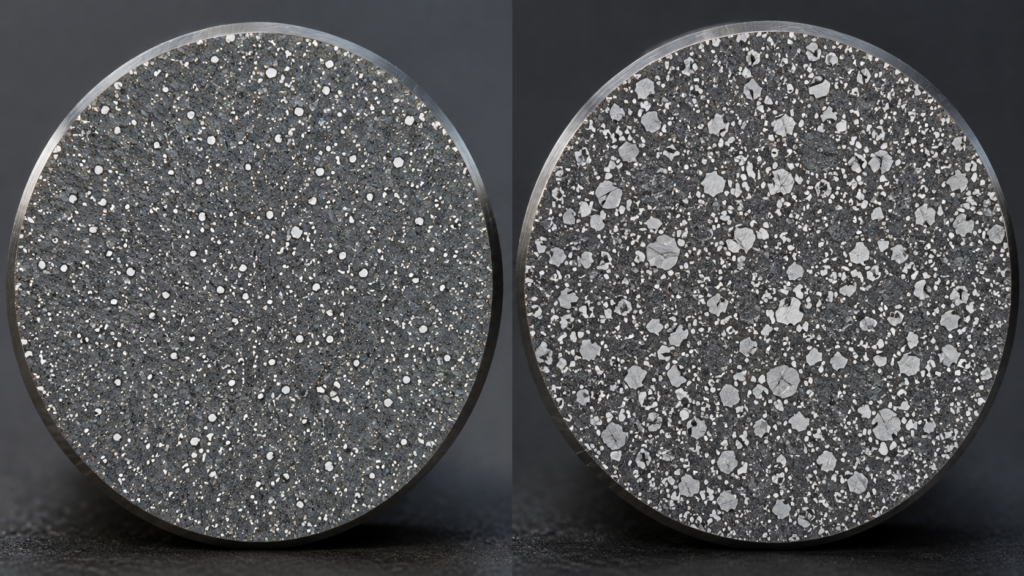
D3 Steel Equivalent and Wear Life for Buyers
The long-tail search D3 steel equivalent and wear life is useful because buyers often source the same material across different standards.
| Standard | Grade |
|---|---|
| AISI | D3 |
| DIN / W.-Nr. | 1.2080 |
| EN | X210Cr12 |
| JIS | SKD1 |
| GB | Cr12 |
SteelNumber’s X210Cr12 material page lists 1.2080 as an alloy cold-work tool steel under EN ISO 4957 and gives a high-carbon, 11–13% chromium range.
Still, equivalent grades are not automatically identical. D3 steel equivalent and wear life depends on chemical range, melting quality, carbide distribution, heat treatment, and the abrasive material.
Which One Lasts Longer in Extreme Wear?
In low-impact abrasive work, D3 can last longer. In D2 vs D3 steel selection, D3 is usually favored when hard particles continuously attack the tool surface and the tool fails by gradual wear instead of cracking.
D3 can be useful for grinding wheel molds, abrasive forming dies, brick and tile mold liners, wear plates, long-run blanking tools for abrasive materials, tableting punches, and certain cold work dies.
A ScienceDirect paper on AISI D3 heat treatment studied mechanical properties and wear behavior after austenitizing and tempering. The point for buyers is simple: D3 performance depends on heat treatment, not only grade selection.
Why D3 Can Outlast D2 in Abrasive Tooling
D3 can outlast D2 when carbide-supported wear resistance matters more than toughness. In abrasive tooling, hard particles attack the working edge again and again. If those particles round the edge before the tool chips, D3 may keep the tool in tolerance for longer.
That is why D2 vs D3 steel matters in extreme wear projects. D3 is not a modern miracle steel. It is an older, more specialized high carbon chromium steel that still earns its place in severe abrasion.
Where D2 Still Wins
D2 is often better when the tool sees shock, interrupted contact, thin edges, complex geometry, or mixed wear. In these cases, toughness may decide service life before wear resistance does.
Use D2 for general cold work dies, punches, slitting cutters, shear blades, and tools where chipping risk is real. If a tool chips before it wears out, D3 is probably solving the wrong problem.
For maintenance teams, D2 vs D3 steel should be reviewed with old tool damage photos, not only with a hardness chart.
Heat Treatment Can Change the Result
ASM International’s chapter on high-carbon, high-chromium cold-work tool steels covers hardening, tempering, microstructure, selection criteria, and applications for D-series grades.
Heat treatment can change D2 vs D3 steel performance in production. Poor austenitizing, quenching, tempering, or stress relief can cause cracking, brittle edges, dimensional instability, and unstable wear life.
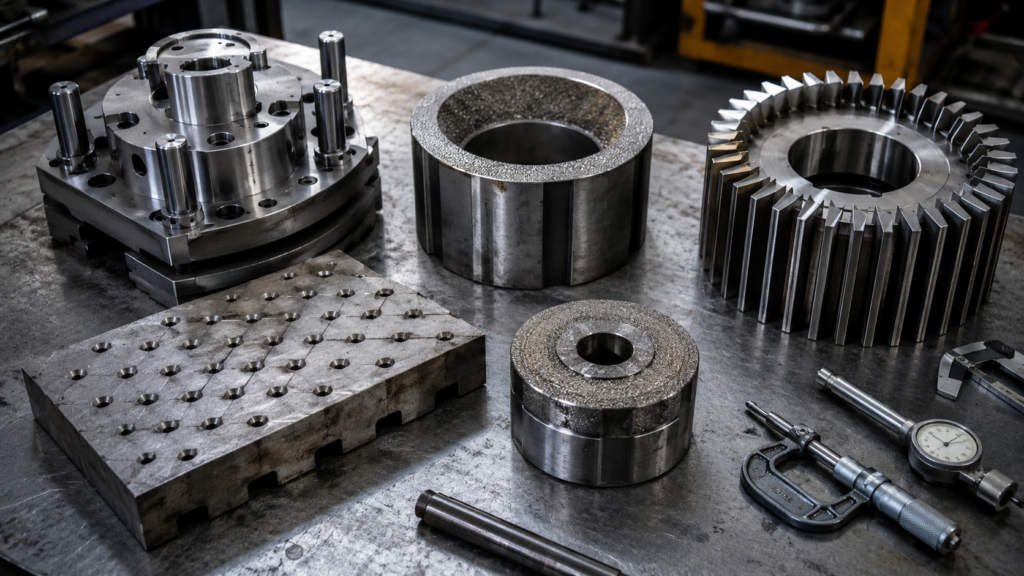
D2 or D3 for Dies, Cutters, and Wear Tools?
| Application | Better Choice | Reason |
|---|---|---|
| General cold work dies | D2 | Better overall balance |
| Grinding wheel molds | D3 | Extreme abrasive wear resistance |
| Abrasive forming dies | D3 | Longer wear life under low impact |
| Punches with shock load | D2 | Lower chipping risk |
| Slitting cutters | D2 | Better edge stability |
| Wear plates | D3 | Strong sliding wear resistance |
| Complex tooling | D2 | Safer toughness and machining |
Which Material Is Better, D2 or D3?
The better material depends on the failure mode. This is the simplest way to answer D2 vs D3 tool steel for buyers.
Choose D2 when the tool must handle wear and impact together. Choose D3 when the main problem is abrasive wear and the working load is stable.
If the tool wears out slowly, D3 may be worth testing. If the tool chips before it wears out, D2 is usually safer.
Conclusion
D2 vs D3 tool steel is not a simple winner-takes-all comparison. D2 is the safer all-round cold work tool steel, while D3 is the more wear-focused option for low-impact abrasive service.
If your tool fails by chipping, cracking, or mixed loading, D2 is usually safer. If your tool fails by gradual abrasive wear, D3 may provide longer service life. In short, D2 vs D3 tool steel is a wear-mode decision, not just a hardness comparison.
In extreme wear applications, D2 vs D3 tool steel should always be decided by the real failure mode, not hardness alone.
FAQ
Why don’t people like D2 steel?
Some users dislike D2 because it can be difficult to sharpen, difficult to machine after hardening, and prone to chipping in thin-edge or impact applications. But D2 is still strong when used correctly.
Is D3 steel good for knives?
D3 can hold an edge well because it has very high wear resistance. However, it is harder to sharpen and less tough than many knife-focused steels.
Why is D3 better than D2?
D3 is better when abrasive wear is the main failure mode. Its higher carbide volume can improve wear life in low-impact dies, molds, and wear tools.
Which material is better, D2 or D3?
D2 is better for balanced toughness and wear resistance. D3 is better for extreme abrasive wear when impact is low.
What is the main D3 steel equivalent?
Common related grades include DIN 1.2080, EN X210Cr12, JIS SKD1, and GB Cr12.
Does heat treatment affect D2 and D3?
Yes. Heat treatment controls hardness, toughness, dimensional stability, and final wear behavior.