
If you are comparing DC53 vs D2, the real question is not only which steel is harder.
The better question is this: why does a D2 punch chip, crack, or lose edge stability even when the hardness looks correct on paper?
his DC53 vs D2 guide explains where D2 still works, where DC53 becomes a smarter upgrade, and how to judge whether the change can reduce tool repair, downtime, and unstable die life.
Why D2 Still Earns Its Place in Cold Work Tooling
D2 is not a weak steel.
It became popular because it offers high hardness, strong wear resistance, good dimensional stability, and broad availability. For many blanking dies, forming dies, thread rolling dies, and wear-focused tooling jobs, D2 remains a practical material choice.
According to AZoM’s article on D2 tool steel, D2 is a high-carbon, high-chromium cold-work tool steel used in long-run tooling where wear resistance is important, including blanking, forming dies, and thread rolling dies. That explains why many workshops still keep D2 as a default grade for conventional cold work applications.
The problem starts when the job is no longer just about wear.
n DC53 vs D2 searches, that is usually the moment the reader is already facing a tooling failure.
Once the tool sees repeated impact, sharp corners, narrow punch sections, tight clearance, or difficult sheet material, the limits of D2 become more visible. That is where DC53 vs D2 becomes a real production decision rather than a simple material comparison.
The D2 Punch Chipping Problem Is Usually a Toughness Problem
Many punch failures are blamed on “bad steel,” but the actual failure mode is often more specific.
The edge does not wear out slowly. It breaks away. It chips at the corner. It develops a small crack that grows into an early failure.
This is the strongest SEO angle for a DC53 vs D2 article: D2 punch chipping problem, D2 tool steel cracking, and D2 die failure are not abstract material topics.
They are the exact issues production teams search for when a tool keeps failing before expected life.
What Makes DC53 Different from Traditional D2?
DC53 was developed as an improvement over SKD11, the Japanese equivalent family often compared with D2.
It is still a cold work die steel, but its value is a better balance of hardness, toughness, wear resistance, and machinability.
Daido Steel’s DC53 datasheet describes DC53 as a high-hardness and high-toughness cold work die steel. Daido’s cold work tool steel page also positions its cold work steel lineup around preventing wear, chipping, and other issues in cold stamping and forging.
A better way to frame it is “wear-focused traditional steel versus toughness-upgraded cold work die steel.”
In many tooling shops, DC53 is considered when D2 performs well for wear but fails too early by edge chipping or cracking.
DC53 vs D2 Performance Comparison for Real Tooling Decisions
A basic DC53 vs D2 datasheet comparison can be useful, but it does not answer the shop-floor question:
Which steel reduces failure in my tooling condition?
| Selection Factor | D2 | DC53 |
|---|---|---|
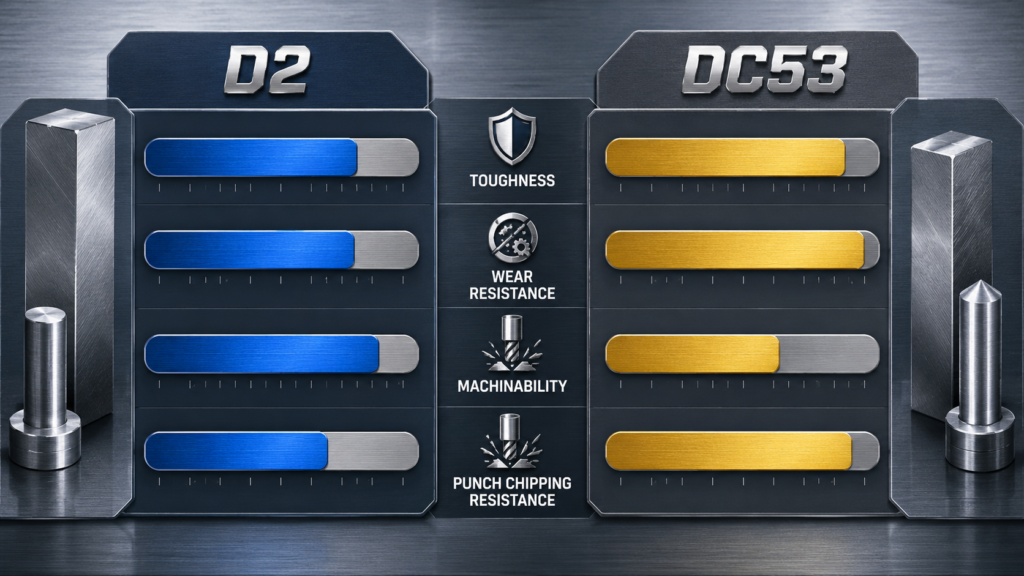
| Main Strength | High wear resistance | Better toughness and balanced wear resistance |
| Typical Failure Risk | Chipping under impact or sharp-edge stress | Lower risk of edge damage in demanding cold work tools |
| Hardness Potential | High | High |
| Machinability | Acceptable in annealed condition, harder after heat treatment | Often easier to machine and grind than D2 |
| Best Fit | Wear-focused dies, lower-impact jobs | Punches, cold work dies, shear tools, and higher-stress tooling |
| Cost Logic | Lower material cost | Higher material cost, but may reduce downtime and rework |
Alro’s DC53 technical sheet notes that DC53 has smaller and more uniformly distributed primary carbides than D2, which helps toughness and fatigue resistance. The same sheet also states that DC53 can typically be machined faster than D2 with less tool wear in many machining conditions.
This is where DC53 vs D2 becomes more than a hardness table.
If your tooling fails by slow abrasive wear, D2 may still be economical.
If your tooling fails by chipping, cracking, or unstable punch life, DC53 can be the more useful option.
Why DC53 Is Better Than D2 for Punches in High-Stress Jobs
Punches fail differently from simple wear plates.
A punch edge sees repeated impact, concentrated stress, friction, and sometimes poor lubrication. If the edge geometry is thin or the punched material is difficult, the steel must absorb stress without breaking.
This is why the long-tail keyword “why DC53 is better than D2 for punches” is a strong content angle.
The answer is not that DC53 is magically better in every job. The answer is that punches need toughness as much as hardness.
In practical terms, DC53 can help when:
- D2 punch edges chip before they wear out.
- Corner cracking appears during high-volume stamping.
- Fine blanking or narrow punch sections create concentrated stress.
- Tool repair is frequent even though hardness is within specification.
- Production cost is driven more by downtime than by raw steel price.
Cold Work Die Steel Improvement Starts with the Failure Mode
Some buyers ask for “better steel” without defining the failure.
That is why a DC53 vs D2 comparison should begin with the damaged tool, not the catalog.
Cold work die steel improvement should start with the failure mode.
Ask these questions before replacing D2:
Ask these questions before replacing D2:
1.Is the tool failing by wear, chipping, cracking, galling, or deformation?
2.Does failure begin at a corner, edge, EDM surface, or thin section?
3.Is the hardness too high for the impact load?
4.Is the punch-to-die clearance stable and properly designed?
5.Does production stop because of sudden breakage rather than predictable wear?
If the main issue is abrasive wear and the die does not see severe impact, D2 may still be a smart choice.
If the main issue is brittle edge damage, the DC53 route becomes easier to justify.
That is the practical value of DC53 vs D2 in procurement. It helps a buyer or engineer avoid choosing steel by reputation and instead choose by how the tool actually fails.
Heat Treatment Can Make or Break Both Materials
No steel grade performs well with poor heat treatment.
D2 can become too brittle if hardness is pushed without enough attention to toughness. DC53 can also underperform if austenitizing, quenching, tempering, EDM stress control, or grinding practice is poorly managed.
Wikipedia’s tool steel overview notes that tool steels are selected by service conditions such as cost, working temperature, hardness, shock resistance, and toughness, and that proper heat treatment is important for performance. While Wikipedia is not a datasheet, it is useful for explaining the broader material-selection logic behind cold work tool steels.
For this reason, a serious DC53 vs D2 review should include heat treatment, not only chemistry.
If a D2 punch chips, the steel grade may be part of the answer, but it is not the only suspect.
For better results, check:
1.hardness target after tempering;
2.section thickness and quenching response;
3.EDM recast layer and stress relief;
4.corner radius and punch edge geometry;
5.grinding burn or microcracks;
6.die clearance and material thickness.
This makes the article more useful for engineers because it does not oversell DC53. It explains how to get better performance from either steel.
When D2 Is Still the Smarter Choice
A balanced article should say this clearly: D2 is not outdated.
Choose D2 when the job is mostly wear-focused, the impact load is moderate, and the tool design has already proven stable.
D2 is also attractive when cost control is important, batch size is not extreme, or the shop already has a reliable D2 heat treatment process.
For long-run tooling where wear resistance is the main requirement, D2 still has strong value.
So the best article position is not “DC53 always beats D2.”
The better position is this: DC53 vs D2 depends on whether your main enemy is wear or chipping.
When Upgrading from D2 to DC53 Makes Commercial Sense
The commercial case in DC53 vs D2 is strongest when material cost is not the biggest cost.
If one punch failure stops a press line, delays shipment, damages parts, or forces repeated tool repair, the cheaper steel may not be cheaper in the real production cost.
In that situation, DC53 can be evaluated as a cold work die steel improvement strategy.
Consider DC53 when:
- D2 punches chip before expected service life.
- The customer requires more stable tool life.
- The die has sharp corners or fragile sections.
- The application involves high-strength sheet, thick sheet, or demanding blanking conditions.
- Regrinding and tool maintenance are becoming too frequent.
- You need better machinability before heat treatment.
This is also where the article can naturally convert readers.
A buyer who searches DC53 alternative to D2 steel is usually not casually browsing. They are likely dealing with a tooling problem that needs a more stable answer.
Practical Selection Guide: DC53 or D2?
Use this DC53 vs D2 guide before ordering material.
Choose D2 if:
- the application is proven and stable;
- wear resistance matters more than impact toughness;
- budget is tight;
- the die is not suffering from edge chipping;
- your heat treatment supplier has strong D2 experience.
Choose DC53 if:
- D2 edge chipping keeps coming back;
- punch cracking appears before normal wear;
- the job involves high-stress cold work tooling;
- downtime costs more than material upgrade;
- you need a better balance of toughness, wear resistance, and machinability.
This is the most useful way to handle DC53 vs D2 in a real project.
Do not start with the steel name. Start with the failure mode, then match the material to the job.
Conclusion
DC53 vs D2 is not a contest where one steel wins every time.It is a practical decision about failure mode.
D2 remains strong when wear resistance, cost control, and proven processing matter most. DC53 becomes more attractive when the real problem is punch chipping, cracking, edge damage, or unstable die life.
If your D2 tool wears out slowly and predictably, there may be no urgent reason to change.
But if your punches fail suddenly, require frequent repair, or cannot hold stable life under impact, DC53 deserves serious evaluation as a cold work die steel improvement option.
FAQ
What is the main difference between DC53 and D2?
D2 is a traditional high-carbon, high-chromium cold work tool steel known for wear resistance.
DC53 is a modified cold work die steel designed to offer better toughness, machinability, and more stable performance in demanding tooling.
Is DC53 better than D2 for punches?
Yes, in many high-stress punch applications.DC53 is often better when the main problem is chipping, cracking, or unstable punch life. If the job is only wear-focused, D2 may still be enough.
Why do D2 punches chip?
D2 punches may chip because of limited toughness under impact, excessive hardness, poor heat treatment, sharp geometry, unsuitable clearance, poor lubrication, or high-stress material conditions.
Can DC53 replace D2 in cold work dies?
Yes, DC53 can replace D2 in many cold work dies, especially when toughness and tool life stability are more important than lowest material cost.
Is DC53 more expensive than D2?
Usually yes.However, if DC53 reduces repair, downtime, and early punch failure, the total tooling cost may be lower than staying with D2.
Is D2 still worth using?
D2 remains useful for wear-focused cold work tooling, moderate-impact dies, and cost-sensitive projects where the failure risk is already under control.