
Selecting the right tool steel is often the thin line between a high-yield production run and a catastrophic failure in the polishing room. In the global plastic injection molding industry, the debate surrounding S136 vs 420 Stainless Steel remains one of the most persistent topics among tooling engineers. While both materials fall under the 400-series stainless category, the gap in their performance—and price—is driven by metallurgical purity rather than just chemical composition.
For project managers in the medical and optical sectors, the choice isn’t about finding the “best” steel in a vacuum. It is about matching the material’s micro-purity to the final product’s surface requirements. In this guide, we will break down the technical nuances of these plastic mold steel grades to help you determine which fits your specific production environment.
ESR vs. Conventional Melting
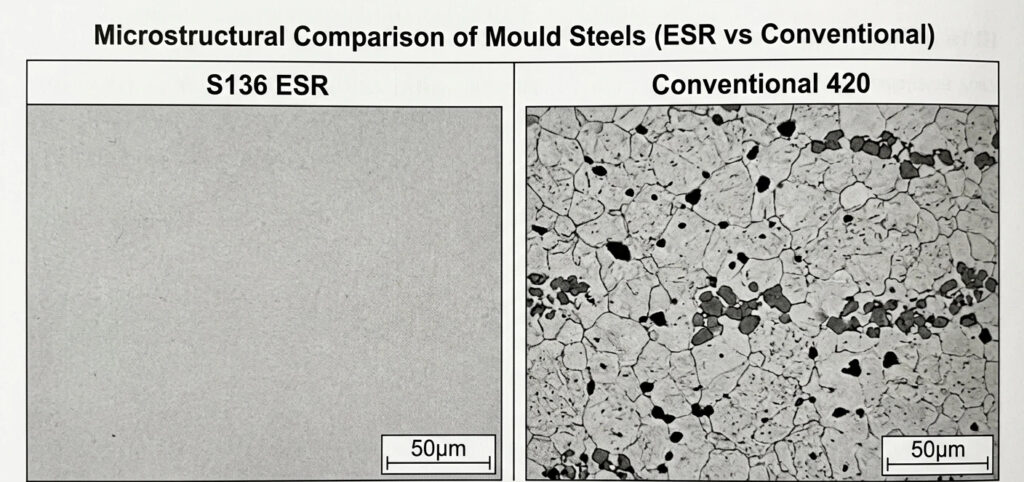
The most significant technical differentiator in the S136 vs 420 Stainless Steel comparison is the refining process. Standard AISI 420 is typically produced through conventional electric arc furnace melting. While this meets the basic chemical requirements for hardness and corrosion resistance, it often leaves behind non-metallic inclusions and carbide segregations.
A Technical Deep Dive into S136 vs 420 Stainless Steel
If your project requires an optical-grade finish, the concept of mirror polish mold steel becomes your primary KPI. This is where the divergence in the S136 vs 420 Stainless Steel performance becomes visible to the naked eye. In conventional 420, the presence of manganese sulfides or large chromium carbides can “pop out” during the high-grit polishing stages, leaving tiny pinholes or “orange peel” textures on the mold surface.
Because S136 is an ESR grade, it allows for a much more consistent abrasion rate across the entire surface. For medical lenses, light guides, or high-gloss consumer electronics, the refined structure of S136 is capable of reaching a true SPI A-1 finish. Conventional 420 is generally limited to A-2 or A-3 finishes, making it more suitable for textured parts or components where slight surface imperfections are hidden by the plastic’s geometry.
Corrosion Resistance for Medical Molds in High-Humidity Environments
Medical manufacturing often takes place in controlled cleanrooms where humidity is strictly monitored. However, the cooling channels within a mold are a different story. The corrosion resistance for medical molds is critical because rust in the cooling lines can lead to clogged channels, uneven cooling, and warped parts.
Heat Treatment and Dimensional Stability
A mold is only as good as its ability to maintain tolerances over a million cycles. When looking at S136 vs 420 Stainless Steel, both can be hardened to roughly 48-52 HRC. However, the uniformity of the ESR process in S136 ensures that the steel expands and contracts evenly during the quenching phase of heat treatment.
In conventional 420, “segregation”—areas where certain elements are more concentrated than others—can cause unpredictable movement during heat treat. This often necessitates leaving more “grinding allowance,” which increases the final machining cost. For complex, multi-cavity molds with tight tolerances, the predictable behavior in the S136 vs 420 Stainless Steel heat-treat cycle often offsets its higher per-kilogram material cost by reducing the time spent in the grinding department. Furthermore, the S136 vs 420 Stainless Steel debate often settles here for high-precision components.
Material Cost vs Total Life-Cycle Value
It is impossible to discuss the S136 vs 420 Stainless Steel choice without addressing the price gap. S136 can cost significantly more than conventional 420. If you are producing low-cost, disposable plastic items with a matte finish, the premium for S136 is likely an unnecessary expense in the S136 vs 420 Stainless Steel economic model.
However, the “Total Life-Cycle Value” tells a different story for high-end applications. If a 420 mold fails the final polishing stage due to a single microscopic inclusion, the cost of the raw material is eclipsed by the hundreds of hours of wasted CNC labor. In the context of best stainless steel for medical injection molds, the material cost is usually less than 10% of the total mold cost. Investing in the higher-purity S136 acts as an insurance policy against late-stage manufacturing defects often found in the S136 vs 420 Stainless Steel comparison of lower grades.
Which Steel Fits Your Environment?
To provide a balanced view, we must look at where each grade excels. The decision shouldn’t be about “good vs bad,” but “appropriate for the ROI of this specific project.” In the S136 vs 420 Stainless Steel selection process, consider these environments:
When to choose Conventional 420:
- Textured Surfaces: If the final part has a “frosted” or leather-like texture, the microscopic purity of ESR steel isn’t necessary.
- Low-to-Medium Volume: For runs under 100,000 cycles, conventional 420 offers sufficient durability.
- Cost-Sensitive Commodities: For household items or large structural parts where optical clarity isn’t required.
When to choose S136 (ESR Grade):
- Optical and Clear Parts: Mandatory for transparent plastics where any surface pit will be magnified.
- High-Purity Medical Gear: When corrosion resistance for medical molds must be paired with ultra-smooth surfaces to prevent bacterial buildup.
- High-Volume Production: For molds intended to run 1,000,000+ cycles, the stability of S136 is superior.
Final Thoughts
The transition between S136 vs 420 Stainless Steel represents a shift from “general engineering” to “precision manufacturing.” If your production environment demands an SPI A-1 finish or involves the stringent requirements of corrosion resistance for medical molds, the refined chemistry of S136 provides a level of predictability that conventional 420 cannot match.
Conversely, for industrial applications where the visual perfection of the mold is secondary to the cost-per-part, 420 remains a robust and reliable workhorse. By evaluating your project based on polishing requirements, cycle count, and the “cost of failure,” you can select the steel grade that optimizes your specific S136 vs 420 Stainless Steel investment ROI.
FAQ
Is S136 always ESR refined?
Most reputable mills produce S136 exclusively as an ESR grade. However, some generic “S136-type” steels in the market may only be vacuum-degassed. Always check the mill certificate for “Electroslag Remelted” status when analyzing the S136 vs 420 Stainless Steel technical specs.
Why does my 420 steel have scratches that won’t go away?
This is often not a scratch, but “cometing.” Tiny hard inclusions in the conventional 420 are harder than the surrounding steel. As you polish, these inclusions tear away, dragging across the surface and creating a tail-like mark.
Can S136 be used for corrosive plastics like PVC?
Yes, but with caution. While both S136 vs 420 Stainless Steel options have high chromium content, PVC releases hydrochloric acid when heated. For extremely high-volume PVC runs, specialized grades might be considered.
Does S136 provide better cooling than 420?
Thermal conductivity is virtually identical. The advantage of S136 is that the cooling channels remain cleaner for longer, maintaining efficiency over the life of the mold.