
For mold makers and tool shop managers, the decision between specifying a globally recognized standard and a regional equivalent often boils down to a single question: will the tool fail? In the high-stakes world of cold work die manufacturing, the debate over Cr12MoV vs D2 is constant. While AISI D2 is the undisputed titan of the Western market, Chinese-produced Cr12MoV has emerged as a formidable challenger, especially when sourced in high-end, export-grade quality.
Let’s be direct. If you are managing a high-volume production line, you aren’t just looking for steel; you’re looking for a balance of wear resistance, toughness, and cost-efficiency. Understanding the technical nuances of Cr12MoV vs D2 is the key to optimizing your tooling budget without sacrificing performance.
Chemical Composition Comparison
To understand if Cr12MoV vs D2 yields identical results, we must first look at the atomic level. Both are high-carbon, high-chromium ledeburitic steels, but the slight variations in alloying elements dictate their behavior during heat treatment.
According to the ASTM A681 standard (the governing specification for tool steels), D2 requires a chromium content between 11.0% and 13.0%. In contrast, Cr12MoV is the Chinese D2 equivalent, formulated with a similar chromium range but often with subtle adjustments in Vanadium and Molybdenum to enhance grain refinement.
| Element | AISI D2 (%) | Cr12MoV (%) |
| Carbon (C) | 1.40 – 1.60 | 1.45 – 1.70 |
| Chromium (Cr) | 11.00 – 13.00 | 11.00 – 12.50 |
| Molybdenum (Mo) | 0.70 – 1.20 | 0.40 – 0.60 |
| Vanadium (V) | 0.50 – 1.10 | 0.15 – 0.30 |
The data confirms that the Cr12MoV properties are remarkably similar to D2. However, D2 typically carries a slightly higher Molybdenum content, which can offer a marginal advantage in through-hardening for exceptionally thick sections. For most standard die components, this difference is negligible, provided the melting process of the Chinese steel is controlled.
Cr12MoV vs D2 Wear Resistance Comparison
In abrasive environments, the primary performance metric is how long the cutting edge stays sharp. This is where the Cr12MoV vs D2 debate gets interesting. Wear resistance is driven by the volume and distribution of primary carbides.
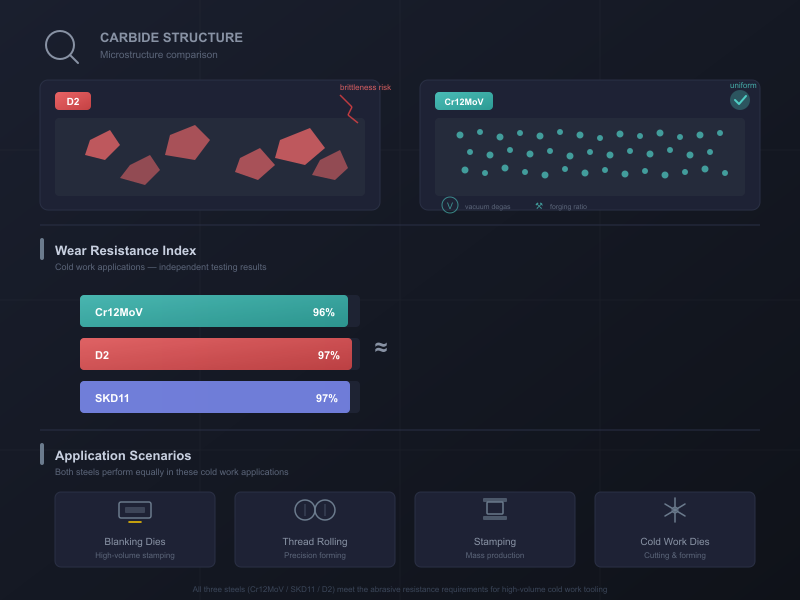
D2 is known for its large, hard chromium carbides. While these provide excellent wear resistance, they can also lead to brittleness if the carbides are too large or poorly distributed. Modern Chinese mills producing Cr12MoV for the international market now utilize vacuum degasification and advanced forging ratios to achieve a uniform carbide distribution.
When comparing Cr12MoV vs D2, independent testing shows that for cold work applications like blanking dies and thread rolling, the wear rates are nearly indistinguishable. The Cr12MoV vs SKD11 vs D2 mechanical properties show that all three materials consistently achieve the necessary abrasive resistance required for high-volume stamping.
Heat Treatment and Secondary Hardening Temperature
The real-world success of any tool steel depends on the skill of the heat treater. A common question from engineers is: Is Cr12MoV the same as D2 steel? Technically, no, but their heat treatment profiles overlap significantly.
Both materials typically aim for a heat treatment hardness (HRC 58-62). However, the secondary hardening temperature for Cr12MoV is a critical factor. To achieve maximum stability and hardness, Cr12MoV is often quenched from 1020°C to 1040°C.
One minor toughness difference between Cr12MoV and AISI D2 arises during the tempering cycle. D2 is slightly more forgiving regarding “temper brittleness.” However, experienced shops using Cr12MoV can mitigate this by utilizing sub-zero treatments (cryogenic processing) to transform retained austenite into martensite, ensuring the tool remains stable over millions of cycles.
Reference: For authoritative data on tool steel quenching cycles, consult the ASM International Heat Treater’s Guide.
The ESR Advantage: Why Quality Sourcing Matters
When people ask how to source high-quality Cr12MoV from China, they are usually worried about “dirty” steel—impurities like sulfur and phosphorus that cause premature cracking. This is where the distinction between “standard” and “premium” becomes vital.
ESR Cr12MoV (Electroslag Remelted) is the gold standard for export. The ESR process acts as a final filtration, removing non-metallic inclusions and creating a dense, isotropic structure. If you are evaluating Cr12MoV vs D2 for a high-precision mold, the ESR version of the Chinese grade will often outperform a standard “Air-Melted” D2 from a generic Western supplier.
Using ESR material ensures that the steel is a best Chinese equivalent to AISI D2 tool steel, capable of handling complex geometries without the risk of internal voids or segregation.
Economic Reality: Cr12MoV Tool Steel Price vs D2 Price per KG
From a procurement perspective, the Cr12MoV vs D2 choice is often driven by the bottom line. It is no secret that Chinese manufacturing scale allows for significant price breaks.
The Cr12MoV tool steel price vs D2 price per kg typically shows a 20% to 35% savings when sourcing the Chinese grade. For a single small punch, this might not matter. But for a global manufacturer producing thousands of dies, these savings represent a massive competitive advantage.
Many Tier-1 automotive suppliers have switched to cost-effective alternatives to D2 for mass production because the performance-to-price ratio of premium Cr12MoV is simply too high to ignore. If the material meets the chemistry and hardness specs, paying the “brand premium” for Western D2 becomes harder to justify.
Applications: Can Cr12MoV Replace D2 for Cold Work Dies?
The short answer is yes. In fact, in many Asian and European manufacturing hubs, this transition happened years ago. Cr12MoV is the workhorse for:
- Long-run blanking and forming dies.
- Shear blades and cold cutting knives.
- Thread rolling dies and cold extrusion tools.
- Master hobs and gauge blocks.
When you look at Cr12MoV vs D2 in these specific environments, the failure rates are identical, provided the heat treatment is executed correctly. For shops looking to optimize, the focus should shift from “Which grade is better?” to “Which supplier has the best quality control?”
Reference: Explore the ASTM A681 standard for a deeper understanding of the alloy classifications that govern these materials.
Conclusion
In the final assessment of Cr12MoV vs D2, the “better” steel is the one that arrives on time, meets its chemical certificate, and fits your budget. The era of doubting Chinese tool steel is over—provided you are sourcing from mills that prioritize vacuum refining and forging ratios.
If your project demands the highest level of trust and budget-friendliness, premium Cr12MoV is no longer just an alternative; it is the industry standard for smart procurement. By focusing on the Cr12MoV properties and ensuring your supplier provides ESR quality, you can achieve world-class tooling results at a fraction of the traditional cost.
When the performance is equal, the smarter price wins every time. Cr12MoV vs D2 isn’t a battle of quality—it’s a battle of value.
FAQ
Is Cr12MoV the same as D2 steel?
They are chemical cousins. Cr12MoV is the Chinese equivalent (GB standard), while D2 is the American (AISI) standard. They are interchangeable in 95% of cold work applications.
What is the maximum hardness for Cr12MoV?
With proper quenching and tempering, it consistently reaches HRC 58-62.
Can Cr12MoV be welded?
Like all high-carbon tool steels, welding is difficult and requires strict pre-heating and post-weld stress relief to prevent cracking.
Why is ESR Cr12MoV better?
The Electroslag Remelting process removes impurities, making the steel tougher and more reliable for precision molds.