
In high-volume industrial manufacturing, the choice of tool steel is the thin line between a profitable production run and a costly mid-shift failure. For decades, standard D2 has been the “workhorse” of the cold work tool steel category. However, as modern engineering demands tighter tolerances, the technical debate of D2 vs CPM D2 has become central to optimizing tool life and reducing maintenance overhead.
The fundamental difference between these materials isn’t just chemical; it is metallurgical. While their chemical compositions are nearly identical, the way those atoms are arranged determines whether a punch or die will last for 50,000 hits or 500,000. When evaluating D2 vs CPM D2, one must look at the micro-level—specifically the carbide distribution in tool steel.
Carbide Segregation in Conventional Steel
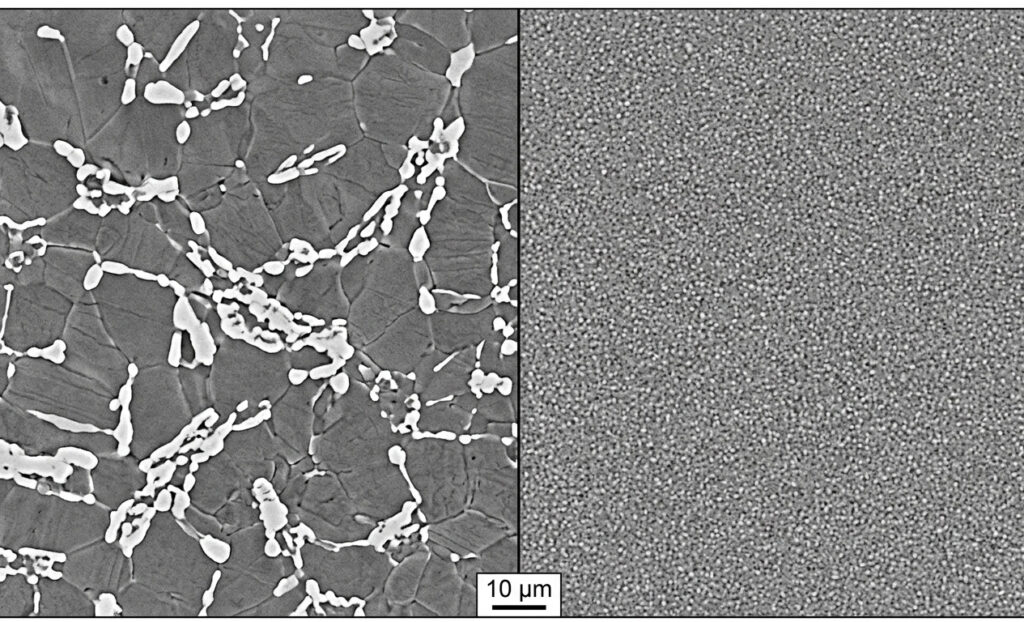
To understand the D2 vs CPM D2 transition, we must look at how standard steel fails at the grain level. Conventional D2 is produced using traditional ingot casting. As the large molten mass of steel cools slowly in a mold, the heavy alloying elements begin to cluster.
This slow cooling leads to a phenomenon known as carbide segregation. In a microscopic view, these carbides form large, brittle “stringers” or “fishbone” structures. For a tool maker, these clusters are essentially internal structural flaws. When analyzing D2 vs CPM D2, it is clear that these clusters act as stress concentrators; when the tool is under high pressure, a crack often begins at one of these large carbide clusters, leading to premature chipping.
How CPM Steel is Made
The breakthrough in this field came with the Crucible Particle Metallurgy (CPM) process. This is the gold standard for powder metallurgy steel. Instead of pouring molten steel into a large mold where it cools slowly, the liquid metal is forced through a high-pressure nozzle and blasted with an inert gas.
This process turns the liquid steel into a fine powder instantly. Because each tiny droplet of powder cools almost immediately, the alloying elements do not have time to segregate. When analyzing D2 vs CPM D2, this uniform distribution is the defining factor. The resulting material lacks the brittle “stringers” found in traditional melts, which is the primary reason why CPM D2 has higher toughness than standard D2.
Comparing Performance: D2 vs. CPM D2
When we test D2 vs CPM D2 in a shop environment, the benefits of the powder metallurgy route become clear across several critical metrics.
1.Isotropic Mechanical Properties
Conventional steel is “directional.” Because of the carbide stringers, the steel is much tougher when the force is applied in one direction versus another. In the D2 vs CPM D2 comparison, powder metallurgy provides isotropic mechanical properties, meaning the steel has the same strength in all directions. For complex mold designs, this consistency is a massive safety net.
2.Wear Resistance vs. Toughness
Usually, you have to choose: you can have a steel that is hard or a steel that is flexible. However, CPM D2 benefits from a “refined” microstructure. By having smaller, evenly dispersed carbides, the steel can achieve a higher hardness without becoming brittle. This balanced performance is a recurring theme when discussing D2 vs CPM D2.
3.Heat Treatment and Machining
Tool makers often struggle with heat treatment consistency in powder metallurgy steels. Standard D2 is notorious for warping during the quench because of its uneven internal structure. In the context of D2 vs CPM D2, the powder version reacts predictably, reducing the “grinding allowance” needed and saving hours in the finishing room.
Technical Specification Comparison
The following table highlights the microstructure difference between conventional D2 and CPM D2 and how it translates to engineering data.
| Performance Metric | Conventional D2 | CPM D2 (Powder Metallurgy) | Engineering Advantage |
| Carbide Size | 20 – 50 Microns | 2 – 4 Microns | Finer edge, less chipping |
| Toughness (Impact) | Lower (Directional) | High (Isotropic) | Prevents breakage under load |
| Wear Resistance | Standard | Enhanced | Longer intervals between sharpening |
| Grindability | Difficult/Uneven | Superior/Predictable | Lower post-processing costs |
| Stability in Heat Treat | Variable | Excellent | Less risk of distortion |
Technical Reference: For peer-reviewed data on the fatigue life of tool steels, refer to the ASM International Materials Database.
Is the Upgrade Worth the Cost?
A common question from procurement is: Is CPM D2 worth the extra cost for high-volume production? When you compare D2 vs CPM D2 solely on raw material price, the powder steel is always more expensive. However, B2B buyers must look at the “Total Cost of Tooling.”
The impact of carbide segregation on mold lifespan is expensive. If a standard D2 mold chips, the production line stops. By switching to a material with the CPM D2 benefits, you are essentially buying “uptime insurance.” In high-speed stamping, the D2 vs CPM D2 cost-benefit analysis usually favors the powder steel due to the massive reduction in downtime. This is the hallmark of cold work tool steel properties—spending more on the alloy to save more on the floor.
When to Specify CPM Steel
While the D2 vs CPM D2 debate usually favors the powder version for high-end tasks, it is most critical in these scenarios:
- Heavy Gauge Stamping: Where impact forces would shatter conventional D2.
- Intricate Mold Inserts: Where warping during heat treatment would ruin a high-value component.
- Abrasive Materials: When cutting glass-filled plastics that wear down standard edges quickly.
By focusing on the elimination of carbide clusters, manufacturers can achieve macro-level results: higher efficiency and more robust industrial tools.
conclusion
Understanding the microscopic nuances of D2 vs CPM D2 is the first step in de-risking your supply chain. Choosing the right powder metallurgy steel ensures your production remains uninterrupted and your tool maintenance costs stay predictable.
FAQ
Can I use the same heat treat recipe for D2 vs CPM D2?
While similar, the D2 vs CPM D2 transition often requires slight adjustments in quenching or tempering to maximize the refined grain structure. Always consult the mill’s datasheet.
Is CPM D2 harder than standard D2?
When comparing D2 vs CPM D2, both generally reach the same 58-62 HRC, but the powder metallurgy version is significantly tougher at that same hardness level.
Why is powder metallurgy steel more expensive?
The process of gas atomization and hot isostatic pressing requires specialized equipment and more energy than simple ingot casting, which increases the production cost.