
In the high-stakes environment of international mold making and tool manufacturing, a misunderstanding of material standards is more than a clerical error—it is a significant financial risk. For procurement managers operating across the US, Europe, and the Middle East, the debate often centers on D2 vs 1.2379 Steel. While these two materials are frequently cited as identical, the subtle nuances in their production standards and regional availability can impact everything from tool life to project overhead.
The primary challenge lies in the transition between the American AISI (American Iron and Steel Institute) system and the German DIN (Deutsches Institut für Normung) system. When a project designed in the United States calls for AISI D2, but the manufacturing facility is located in Germany or Dubai, engineers must confirm the AISI D2 to DIN 1.2379 cross reference with surgical precision.
Understanding the Standards: Is 1.2379 the same as D2?
To answer the common question—Is 1.2379 the same as D2?—one must look at the metallurgical intent. Both are high-carbon, high-chromium ledeburitic tool steels. They are designed for applications requiring high wear resistance and excellent compressive strength, such as blanking dies, thread rolling dies, and shear blades.
The term DIN 1.2379 equivalent is widely used in European markets because 1.2379 was specifically developed to improve upon the older DIN 1.2080 (D3) standard, aligning more closely with the American D2 chemistry. However, “equivalent” does not mean “identical.” While the primary alloying elements—Chromium, Carbon, Molybdenum, and Vanadium—are present in both, the permissible ranges for these elements can differ slightly between the ASTM A681 and DIN EN ISO 4957 standards.
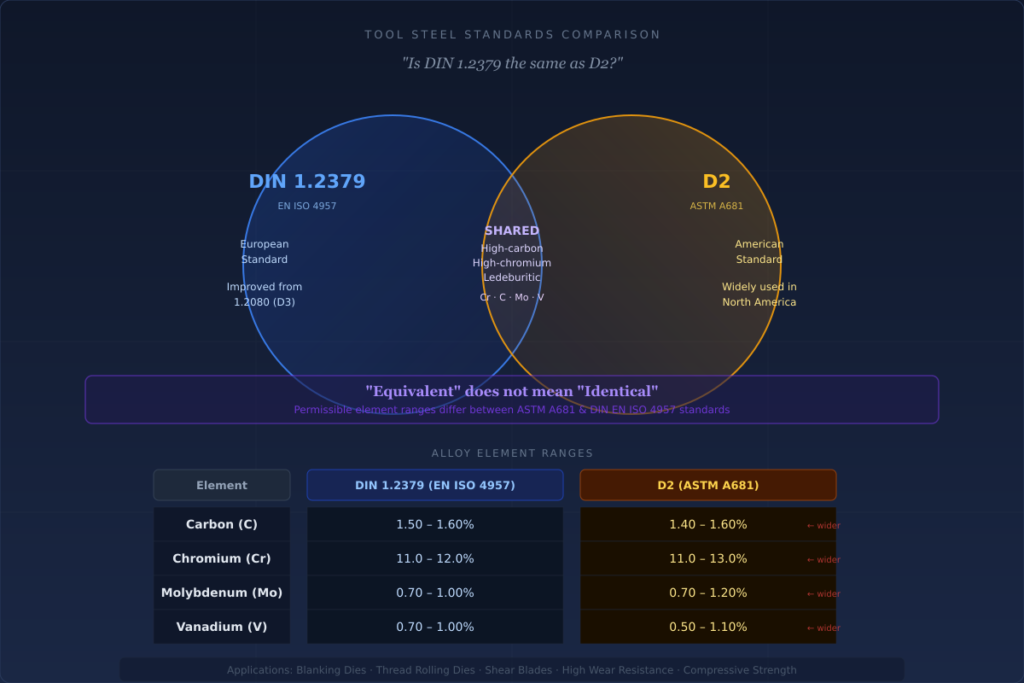
Technical Comparison: DIN 1.2379 Chemical Composition Equivalent
The core of the D2 vs 1.2379 Steel comparison lies in the chemical matrix. These alloys rely on a high volume of Chromium carbides to provide their signature wear resistance. A precise DIN 1.2379 chemical composition equivalent ensures that the material will respond predictably to heat treatment, regardless of the country of origin.
| Element | AISI D2 (%) | DIN 1.2379 (X153CrMoV12) (%) |
| Carbon (C) | 1.40 – 1.60 | 1.45 – 1.60 |
| Chromium (Cr) | 11.00 – 13.00 | 11.00 – 12.00 |
| Molybdenum (Mo) | 0.70 – 1.20 | 0.70 – 1.00 |
| Vanadium (V) | 0.50 – 1.10 | 0.70 – 1.00 |
| Silicon (Si) | 0.10 – 0.60 | 0.10 – 0.60 |
| Manganese (Mn) | 0.10 – 0.60 | 0.20 – 0.60 |
As observed in the table, 1.2379 often has a slightly narrower range for Chromium and Molybdenum, which can lead to a more consistent carbide distribution in high-end European melts. This is a critical factor when choosing the D2 tool steel European equivalent for high-precision automotive tooling.
Mechanical Performance: Hardness and Toughness
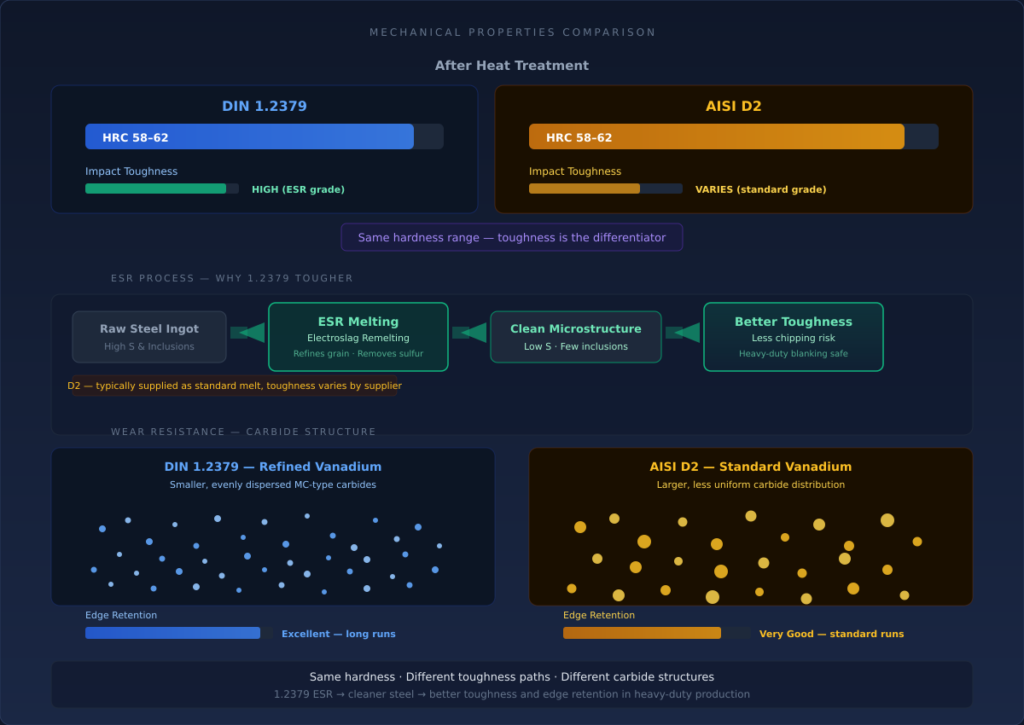
When evaluating D2 vs 1.2379 Steel, mechanical properties often dictate the final choice. The most critical metric for toolmakers is the 1.2379 vs D2 hardness after heat treatment. Generally, both materials can achieve a working hardness of 58-62 HRC.
However, the impact toughness of DIN 1.2379 vs AISI D2 can vary based on the melting process. In many Middle Eastern and European markets, 1.2379 is often supplied as ESR (Electroslag Remelted) steel. This process significantly reduces sulfur content and non-metallic inclusions, resulting in a cleaner microstructure. This cleanliness directly translates to better toughness and less risk of “chipping” during heavy-duty blanking operations.
Furthermore, a wear resistance comparison 1.2379 vs D2 reveals that both steels perform exceptionally well in abrasive environments. Because 1.2379 often features a slightly more refined Vanadium content, it tends to form smaller, more evenly dispersed MC-type carbides, which can enhance the tool’s edge retention over long production runs.
Sourcing and Global Economics: D2 vs 1.2379 Price per kg
For international procurement, the choice often boils down to logistics. The D2 vs 1.2379 price per kg is heavily influenced by regional tariffs, energy costs in the manufacturing country (e.g., Germany vs. China), and shipping distances.
In the Middle East, particularly in industrial hubs like Saudi Arabia and the UAE, European-sourced 1.2379 is often perceived as the premium choice due to the stringent quality controls of German mills. However, for cost-sensitive projects, high-quality D2 from reputable Asian mills can offer a significant price advantage without sacrificing more than a marginal percentage of tool life.
When negotiating contracts, always clarify the manufacturing standard. Requesting an AISI D2 vs DIN 1.2379 technical data sheet from the supplier is the only way to verify that you are not paying a premium for a “brand” when the metallurgical properties are nearly identical.
Applications: Where the Comparison Matters Most
The decision between D2 vs 1.2379 Steel is most impactful in the following industries:
- Automotive Stamping: Requires high-impact toughness to prevent die failure during 24/7 production.
- Pharmaceutical Tableting: Needs extremely clean steel (often 1.2379 ESR) to prevent contamination and withstand abrasive powder compression.
- Recycling/Shredding: Focuses on the extreme wear resistance of the D2 grade to handle plastic and metal scrap.
If your design originates in the EU, stick with the D2 tool steel European equivalent (1.2379) to ensure your local heat treater is using familiar quenching curves. Conversely, for US-based projects, specifying D2 ensures compatibility with domestic ASTM standards.
Conclusion
In the debate of D2 vs 1.2379 Steel, the winner is ultimately determined by your supply chain geography and the specific demands of your tooling. By mastering the AISI D2 vs DIN 1.2379 relationship, procurement professionals can eliminate the “standard-gap” that often plagues international projects. Whether you prioritize the refined carbide structure of a European 1.2379 or the cost-effective reliability of an AISI D2, understanding the metallurgical DNA of these steels is the key to industrial excellence.
FAQ
Can I use D2 and 1.2379 interchangeably?
Yes, in 95% of cold-work applications, they are interchangeable. However, always verify the chemical composition if your application involves high-cycle fatigue or extreme precision.
Which is better for heat treatment?
Both respond well to vacuum hardening. However, 1.2379 vs D2 hardness after heat treatment tends to be slightly more consistent in 1.2379 due to its tighter elemental ranges in European standards.
Why is 1.2379 often more expensive?
The price difference in the D2 vs 1.2379 price per kg is usually due to the melting process (ESR) and the higher energy and labor costs associated with European production compared to standard D2 melts.
How do I verify a “DIN 1.2379 equivalent” from a new supplier?
Ask for a Mill Test Certificate (MTC) and check it against the AISI D2 to DIN 1.2379 cross reference table provided in this guide. Look specifically at the Vanadium and Molybdenum levels.