
Choosing the right coated steel affects durability, lifecycle cost and maintenance needs. This comparison — Galvalume vs Galvanized — summarizes how aluminum-zinc alloy coatings differ from pure zinc coatings and explains when each option makes sense for roofing, appliances and general fabrication. When comparing Galvalume vs Galvanized, consider exposure, coating weight, and fabrication needs to select the best-coated steel for the job.
Composition and standards
Galvalume is an aluminum-zinc alloy coating typically composed of ~55% aluminum, ~43.4% zinc and ~1.6% silicon applied by continuous hot-dip coating to a cold-rolled steel substrate; by contrast, galvanized products use a nearly pure zinc coating. The alloy composition gives Galvalume a barrier layer from aluminum combined with sacrificial protection from zinc.
Material and coating specifications for 55% aluminum-zinc alloy coated steel are standardized under ASTM A792 and related specifications, helping ensure consistent quality across manufacturers. These standards are published by ASTM International and widely adopted in purchasing and engineering specifications. When ordering Galvalume vs Galvanized products, specify coating designation (e.g., AZ55), coating weight, and required test certificates.
Key Differences at a Glance — Galvalume vs Galvanized
| Feature | Galvalume Steel | Galvanized Steel |
|---|---|---|
| Coating Composition | 55% aluminum, 43.4% zinc, 1.6% silicon | Nearly 100% zinc |
| Corrosion Resistance | Typically 2–4× longer service life in many environments | Good corrosion protection but generally shorter lifespan |
| Heat Reflectivity | Higher reflectivity due to aluminum | Lower heat reflectivity |
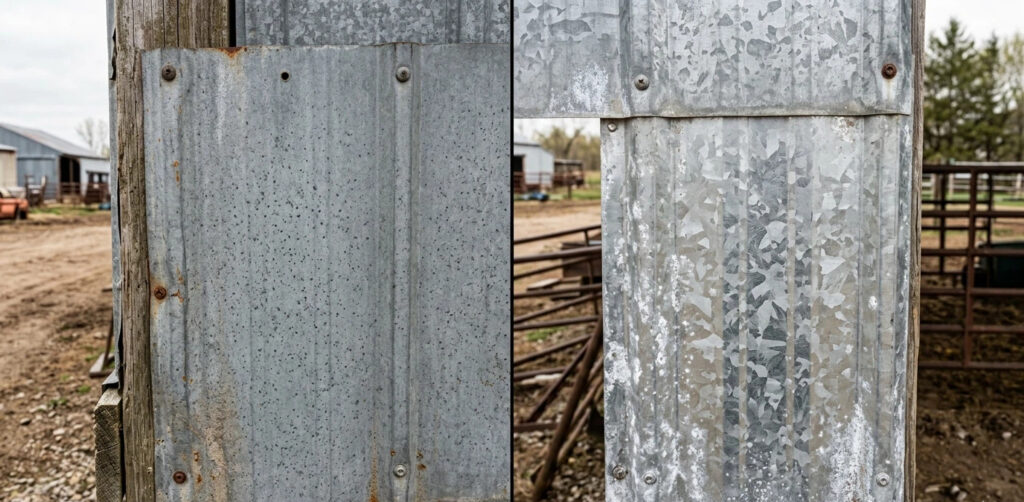
| Surface Appearance | Silver spangled finish | Dull gray zinc finish |
| Paint Adhesion | Excellent with proper pretreatment | Good; may need different pretreatments |
| Formability | Good; avoid very tight-radius bends | Good, often more forgiving in heavy forming |
| Typical Applications | Roofing, wall cladding, appliance panels | Structural members, fencing, hardware |
| Relative Cost | Slightly higher initial cost | Lower initial material cost |
Corrosion resistance: real-world performance
One of the clear differences in Galvalume vs Galvanized is corrosion resistance. In many exposure conditions Galvalume delivers roughly two to four times the resistance to red rust compared with standard galvanized coatings, especially on horizontal or exterior roof surfaces where barrier protection matters most. This performance makes Galvalume the common choice for long-life roofing systems and exposed cladding.
That said, field performance depends on environment (coastal splash vs inland), coating weight, paint systems and detailing such as cut-edge protection. In highly abrasive or mechanically exposed conditions, galvanized zinc’s sacrificial action at damaged areas can still be advantageous. Asking “is Galvalume better than galvanized?” therefore requires specifying the exposure and expected service life when you evaluate Galvalume vs Galvanized.
Thermal reflectivity, paintability and formability
Galvalume’s aluminum component provides better heat reflectivity than pure zinc, which can reduce rooftop surface temperatures and improve building energy performance in hot climates. Both prepainted Galvalume Steel Coil and Galvanized Steel Coil accept paint well; still, the aluminum-rich surface on Galvalume often improves long-term paint adhesion when correct pretreatments are applied.
From a fabrication standpoint, Galvalume generally offers excellent formability, but sharp bends and tight-radius forming require attention because the alloy coating can be more brittle under extreme deformation. For designs with many tight bends, trial forming is recommended before committing to full production—this simple check helps compare performance in real life when deciding Galvalume vs Galvanized.
Welding and processing considerations
Welding aluminum-zinc coated steel requires process control to prevent porosity and to address coating vaporization that can affect weld quality. Local removal of coating at weld joints, proper ventilation and manufacturer welding recommendations mitigate these issues. Zinc vapor from galvanized materials poses similar welding considerations, so both materials require disciplined welding practices depending on whether you choose Galvalume or galvanized steel.
Cost comparison and lifecycle considerations
Upfront material cost for Galvalume can be higher than standard galvanized steel, but lifecycle cost comparisons often favor Galvalume for roofs and exposed building envelopes because reduced corrosion rates lower maintenance and replacement frequency. When performing a cost comparison Galvalume vs Galvanized, include expected service life, coating weight, paint system and local climate — these factors typically determine whether the higher initial cost becomes a long-term saving.
Typical applications: when to choose which
- Choose Galvalume for long-life roofing, wall cladding and applications where corrosion exposure is moderate to high but mechanical abrasion is limited (architectural panels, appliance panels, some heat components).
- Choose Galvanized where sacrificial protection at cut edges or in highly abrasive environments is the priority, or where budget constraints favor a lower initial material cost. Practical procurement often includes a side-by-side evaluation of Galvalume vs Galvanized properties for the exact service conditions.
Market and industry datasets reflect increasing use of high-performance coated steels in construction and appliances; adoption trends favor coatings that improve lifecycle value. Data from the global steel body World Steel Association show broader uptake of specialty coated products in building applications, which is relevant when comparing Galvalume vs Galvanized for large projects.
Practical recommendation
When preparing specifications, list coating designation (e.g., AZ55), coating weight, paint pretreatment and edge-protection details. Ask suppliers for test certificates (coating composition, adhesion, salt spray where relevant) and, if possible, produce a small mock-up for in-service exposure testing—this helps validate choices between Galvalume vs Galvanized for your exact conditions.
Conclusion
In the Galvalume vs Galvanized debate there is no single universal winner. Galvalume’s aluminum-zinc alloy provides superior corrosion resistance and heat reflectivity that often deliver better lifecycle value for roofing and exposed surfaces, while galvanized steel remains a cost-effective and sacrificially protective option for specific exposure and fabrication scenarios. Match material selection to environment, fabrication needs and total cost of ownership to make the right choice.
FAQ
Is Galvalume better than galvanized for roofing?
Often yes — for many climates Galvalume lasts 2–4× longer and resists corrosion better, making it a strong roofing choice. That said, coastal splash zones and very abrasive contexts still need careful evaluation in the Galvalume vs Galvanized trade-off.
Does Galvalume accept paint?
Yes — with proper pretreatment, Galvalume Steel Coil is widely used in color-coated panels and architectural systems.