
Selecting the right alloy for high-stress components often feels like a balancing act between cost, durability, and chemical stability. Within the world of martensitic stainless steel, two grades frequently dominate the conversation: 420 and 440C. While both belong to the same family of heat-treatable alloys, the performance gap between them is vast.
Understanding the 420 vs 440C stainless debate is critical for engineers and procurement managers alike. Choosing the wrong grade can lead to premature mechanical failure or unnecessary manufacturing expenses. In this guide, we will strip away the marketing jargon and look at the metallurgical data to determine which steel wins for your specific application.
The Metallurgical DNA of Martensitic Stainless Steel
To understand the differences in 420 vs 440C stainless, we first have to look at their chemical “DNA.” Both are martensitic steels, meaning they possess a crystalline structure that can be significantly hardened through quenching and tempering. Unlike the 300-series (austenitic) steels used in kitchen sinks, these grades are magnetic and designed specifically for high-strength applications.
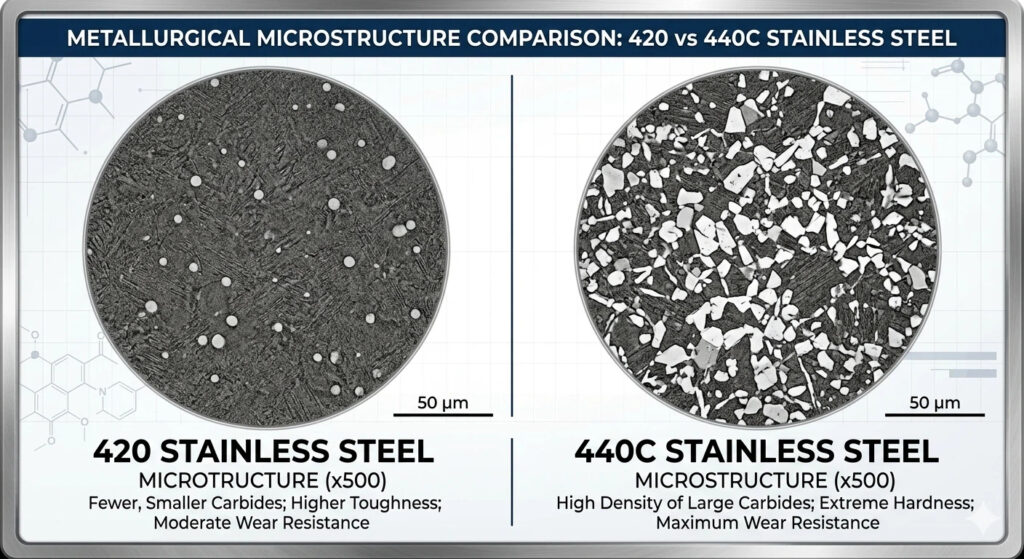
The primary differentiator is carbon content. 420 stainless steel typically contains between 0.15% and 0.40% carbon. In contrast, 440C is a high-carbon monster, boasting levels between 0.95% and 1.20%. This difference in carbon dictates how many chromium carbides are formed during heat treatment, directly impacting the material’s final hardness and wear resistance.
According to ASM International, the higher carbon in 440C allows for the formation of large, primary carbides that act like “armor” within the steel matrix. For a technical deep-dive into the ASTM standards for these grades, you can reference the ASTM A276 Standard Specification.
420 Stainless Steel vs 440C: The Hardness and Wear Gap
The most significant metric in the 420 stainless steel vs 440c comparison is the Rockwell Hardness (HRC). After heat treatment, 420 usually peaks around 50–52 HRC. This level offers good strength but is relatively “soft” compared to its high-carbon counterparts.
440C, however, can easily reach 58–60 HRC. This 10-point jump on the Rockwell scale isn’t just a number; it represents a massive increase in compressive strength and wear resistance. In environments where the material is subjected to constant friction or abrasive forces, 440C will outlast 420 by a significant margin.
However, hardness comes at the price of toughness. Steel is a zero-sum game: as you increase hardness, you generally decrease impact resistance. This is where the 420 vs 440C stainless choice becomes tricky. 420 is much less likely to chip or shatter under a sudden impact, making it the preferred choice for tools that might be subjected to prying or heavy shock loads.
440C vs 420 for Bearings and Knives
The most frequent industry application for these metals is found in the cutlery and precision movement sectors. When evaluating 440C vs 420 for bearings and knives, the decision usually hinges on “edge retention” versus “toughness.”
The Blade Perspective
In the knife industry, 440C is often considered the “king of the classics.” Its high carbon content allows it to hold a razor edge for a long time, even when cutting abrasive materials like rope or cardboard. On the other hand, 420 is widely used in diving knives and surgical instruments. Because 420 is easier to sharpen and more ductile, it can be ground into very thin, flexible blades that won’t snap during delicate procedures.
The Bearing Perspective
For precision ball bearings, 440C is the gold standard. The high hardness prevents the “flat spotting” of the balls under high loads. In a direct comparison of 440C vs 420 for bearings and knives, 440C wins in high-load, high-RPM environments because it resists the microscopic deformation that leads to bearing vibration and failure. 420 bearings are generally reserved for low-load applications where cost-saving is more important than absolute longevity.
For bearing load ratings and material performance, the SKF Technical Library provides extensive data on stainless steel bearing life.
Which Grade Survives Best?
There is a common misconception that higher-grade steel always means better corrosion resistance. In the case of 420 vs 440C stainless, the reality is the opposite.
While 440C has more chromium (16–18%) than 420 (12–14%), much of that chromium is “locked up” in the carbon carbides. Chromium that is tied up in carbides cannot participate in forming the passive oxide layer that prevents rust. Therefore, 420 often exhibits superior corrosion resistance in freshwater and mild atmospheric conditions, especially when it has been given a mirror-polish finish.
If your component will be exposed to saltwater or harsh chemicals, neither of these is ideal. However, if you must choose between the two, 420 often provides a more stable passive layer. It is a critical factor when deciding on 420 vs 440C stainless for outdoor hardware or marine tools.
Machinability and Cost
From a procurement and production standpoint, 420 vs 440C stainless represents two very different budget lines. 420 is significantly easier to machine in its annealed state. It is “gummy” but soft, allowing for faster spindle speeds and longer tool life for your CNC inserts.
440C is a nightmare for cutting tools. The high volume of hard carbides makes it incredibly abrasive. Even in the annealed state, it will wear down end mills and drills much faster than 420. Furthermore, the grinding process after heat treatment is more labor-intensive for 440C, as it requires specialized abrasive wheels to achieve a high-tolerance finish.
When we look at the total project cost of 420 vs 440C stainless, 440C usually carries a 20–40% premium in both raw material price and machining labor. If your application doesn’t strictly require 60 HRC, 420 is the smarter financial choice.
Heat Treatment Protocols for Maximum Reliability
To get the most out of 420 vs 440C stainless, the heat treatment must be precise. Both require a multi-stage process:
1.Pre-heating: To prevent thermal shock.
2.Austenitizing: Heating to roughly 1850°F–1950°F.
3.Quenching: Usually in oil or air.
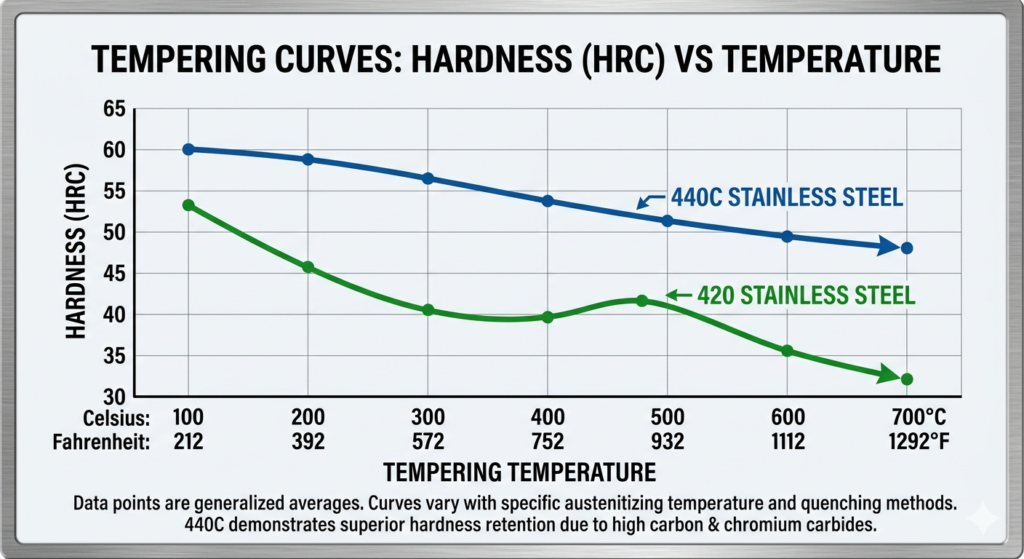
4.Tempering: Crucial for removing internal stresses.
A common mistake in 420 vs 440C stainless processing is improper tempering. 440C, in particular, is susceptible to “temper embrittlement” if held at the wrong temperature range, which can cause the steel to become as brittle as glass.
Summary Comparison Table
| Feature | 420 Stainless | 440C Stainless |
| Typical Hardness (HRC) | 50 – 52 | 58 – 60 |
| Carbon Content | 0.15% – 0.40% | 0.95% – 1.20% |
| Wear Resistance | Moderate | Excellent |
| Toughness | High | Low |
| Machinability | Good | Poor |
| Best For | Surgical tools, prying tools | Bearings, high-end knives |
Final Verdict
In the final evaluation of 420 vs 440C stainless, the winner is determined by your “Failure Mode.” If your part is likely to fail because it wears down or deforms under pressure, 440C is your only option. However, if your part is likely to fail because it snaps or rusts in a damp environment, 420 is the superior engineering choice.
When looking at 440C vs 420 for bearings and knives, remember that high performance always demands a higher price—not just in material costs, but in the complexity of the manufacturing process. By understanding the chemical trade-offs of these martensitic stainless steel grades, you can build products that aren’t just hard, but are built to last.
Whether your next project involves a precision bearing assembly or a high-performance blade, the 420 vs 440C stainless decision will define your success. Choose for reliability, not just for the highest numbers on a data sheet.
FAQ
Can 420 reach the same hardness as 440C?
No. 420 lacks the necessary carbon to achieve the high HRC levels seen in 440C, regardless of the heat treatment method.
Is 440C magnetic?
Yes. Since both are martensitic stainless steel grades, they are strongly magnetic.
Which grade is better for food processing?
Both can be used, but 420 is often preferred for large-scale blades due to its higher corrosion resistance and lower cost, while 440C is used for high-speed cutters and grinders.
How does 420 vs 440C stainless perform in high temperatures?
440C maintains its hardness better at elevated temperatures, though neither should be used in continuous service above 800°F (427°C).