
17-4PH vs 316L is a real engineering choice when a stainless part must resist corrosion but also carry load, hold threads, resist wear, or avoid bending in service. 316L is often the safer corrosion-focused grade, especially around chlorides. 17-4PH is the stronger precipitation hardening stainless option, but it should be evaluated carefully in marine and chemical environments.
Why 316L Is Popular but Not Always Strong Enough
316L stainless steel is widely used because it combines corrosion resistance, weldability, and stable performance in many wet or chemically exposed environments. The grade contains molybdenum, which improves resistance to pitting and crevice corrosion in chloride environments, as explained in the World Stainless grade datasheets.
That is why 316L is commonly used for marine fittings, chemical equipment, pipework, tanks, and welded assemblies. The problem appears when the same part also needs high strength. Pins, shafts, valve stems, pump components, threaded fasteners, and load-bearing brackets may deform, wear, or lose preload if the material is too soft for the service condition.
This is where 17-4PH vs 316L becomes more than a corrosion discussion. It becomes a load, hardness, and lifecycle performance decision.
What Makes 17-4PH a Precipitation Hardening Stainless Steel?
17-4PH is a martensitic precipitation hardening stainless steel. According to the Wikipedia overview of 17-4 stainless steel, it contains roughly 15–17.5% chromium, 3–5% nickel, and 3–5% copper, and it can be heat treated to develop high strength and hardness.
The strengthening mechanism is the key. After solution treatment and aging, fine precipitates form in the steel matrix, improving mechanical strength. TWI’s technical note on precipitation hardening stainless steels explains that 17/4PH is one of the common martensitic PH grades and is strengthened by aging after transformation.
That makes 17-4PH attractive for high strength stainless steel parts where 316L is corrosion-resistant but mechanically underpowered.
17-4PH vs 316L Strength Comparison
17-4PH vs 316L usually favors 17-4PH when strength, hardness, and load-bearing capacity are the main concerns. A 2024 open-access study on 17-4 precipitation hardening stainless steel found that precipitation hardening heat treatment increased ultimate tensile strength and hardness, confirming why this grade is chosen for higher-strength components.
Typical selection logic:
| Factor | 17-4PH | 316L |
|---|---|---|
| Stainless family | Precipitation hardening stainless | Austenitic stainless |
| Strength after treatment | Much higher | Moderate |
| Hardness | Higher | Lower |
| Load-bearing parts | Strong fit | Limited |
| Weldability | Needs more control | Generally easier |
| Corrosion priority | Good, but environment-dependent | Usually stronger in chloride service |
For shafts, pins, fasteners, and valve stems, 17-4PH vs 316L often points toward 17-4PH if the part is failing by bending, thread damage, wear, or insufficient hardness.
Corrosion Resistance: Where 316L Still Has the Safer Margin
17-4PH vs 316L should not be answered by strength alone. In many marine and chloride-rich environments, 316L has the safer corrosion margin because molybdenum improves resistance to localized attack. The Wikipedia page on marine grade stainless notes that 316 is commonly treated as a minimum grade near seashore environments, while seawater immersion may require more resistant stainless families.
17-4PH also has useful corrosion resistance, but it is not simply a stronger version of 316L. Its corrosion behavior depends on heat treatment condition, surface finish, passivation, chloride level, temperature, and whether the part is exposed to stagnant seawater, splash zones, or chemical media.
For continuous seawater immersion, highly aggressive chloride service, or strong acids, 17-4PH vs 316L may still favor 316L—or even a higher alloy—unless testing confirms 17-4PH is acceptable.
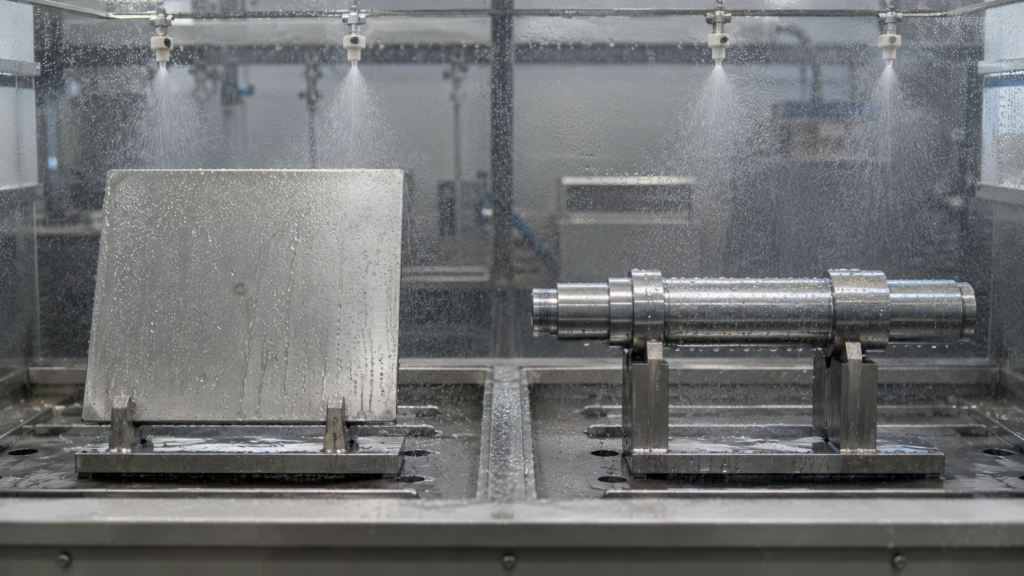
17-4PH vs 316L for Marine Hardware
17-4PH vs 316L for marine hardware depends on whether the part is mainly fighting corrosion or mechanical load.
For deck fittings, rails, and low-load exposed parts, 316L is often a practical choice because corrosion resistance and appearance matter more than hardness. For pins, shafts, couplings, lock components, and high-load fasteners, 17-4PH can be more attractive because it offers higher strength and better resistance to deformation.
A professional video can help readers understand why marine corrosion is not one condition. The British Stainless Steel Association’s YouTube talk on stainless steel in marine applications discusses corrosion risks in marine environments and why exposure type matters.
The key is not choosing one “marine grade” for everything. 17-4PH vs 316L should be decided by load level, chloride exposure, service life, inspection access, and failure consequence.
316L vs 17-4PH for Chemical Equipment
Chemical equipment creates a different challenge. 316L is widely used in tanks, piping, fittings, and welded assemblies because it offers broad corrosion performance and easy fabrication. 17-4PH can be useful in chemical plants for high-strength parts such as valve stems, pump shafts, pins, and mechanical connectors.
However, chemical compatibility must be checked first. Temperature, pH, chloride content, oxidizing or reducing conditions, and cleaning chemicals can change the answer. 17-4PH vs 316L may favor 17-4PH in a loaded mechanical part, but the same choice could be risky in a highly corrosive fluid path.
Buyer Insight: If a component is both stressed and exposed to corrosive media, ask for material certificates, heat treatment condition, surface treatment details, and corrosion history in similar service.
When Should You Choose 17-4PH Instead of 316L?
Choose 17-4PH when the main problem is mechanical performance:
- 316L is bending, wearing, or galling too quickly.
- The part needs higher hardness.
- The design requires better load-bearing capacity.
- The part is a shaft, pin, fastener, valve stem, or pump component.
- Corrosion exposure is moderate and controlled.
- Heat treatment condition can be specified and verified.
Choose 316L when corrosion is the first priority:
- The part is continuously exposed to chlorides.
- Welding and fabrication are central to the design.
- The component is not highly loaded.
- Surface appearance and corrosion margin matter more than hardness.
- The environment includes salt spray, wet service, or chemical washdown.
In practical terms, 17-4PH vs 316L is not a winner-takes-all comparison. It is a trade-off between strength reserve and corrosion margin.
When 17-4PH Should Not Replace 316L
17-4PH vs 316L should be treated carefully when the environment is aggressive. Do not replace 316L with 17-4PH only because the part needs more strength.
Be cautious if the part sees:
1.Stagnant seawater
2.Strong chloride concentration
3.Crevice-prone design
4.Strong acids or unknown chemicals
5.Heavy welding requirements
6.No control over heat treatment condition
7.No passivation or surface finishing plan
17-4PH can solve strength limits, but wrong environment matching can create a corrosion problem that strength cannot fix.
Key Buying Questions Before Choosing 17-4PH or 316L
Before purchasing stainless steel for marine hardware or chemical equipment, ask these questions:
- Is the failure caused by corrosion, deformation, wear, or fatigue?
- Will the part contact seawater, salt spray, or chloride chemicals?
- Is welding required?
- Is precipitation hardening treatment specified?
- What hardness or strength range is required?
- Is surface passivation needed?
- What standard, certificate, or inspection document is required?
- What is the cost of failure or downtime?
These questions make 17-4PH vs 316L a structured material decision instead of a simple grade comparison.
Conclusion
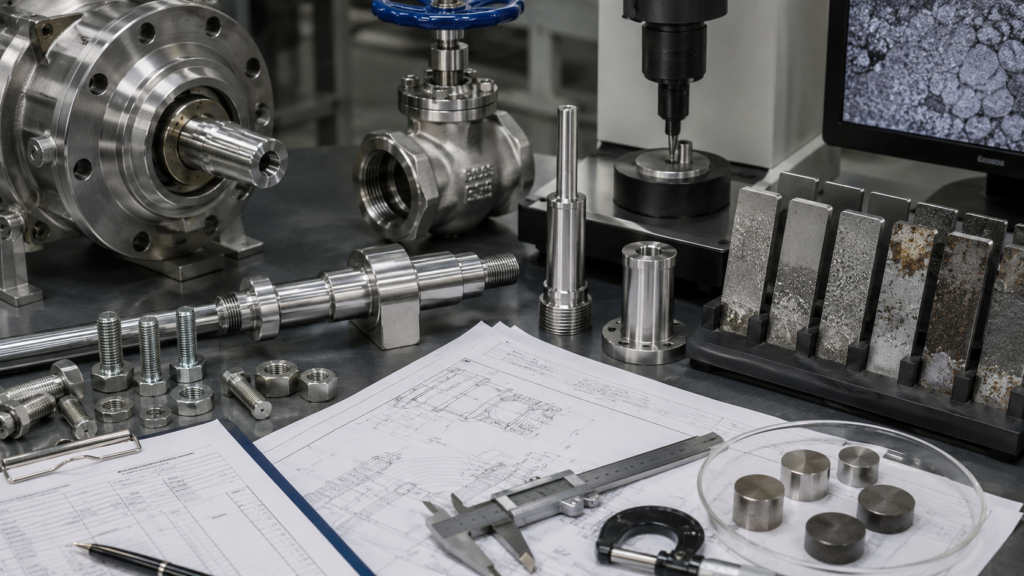
17-4PH vs 316L should start with the failure mode. If a part is failing from corrosion, 316L may be the safer choice. If the real issue is softness, bending, wear, thread damage, or load-bearing limits, 17-4PH deserves a closer look.
For marine hardware, chemical equipment, shafts, pins, valve stems, and fasteners, the best decision is not simply choosing the “stronger” or “more corrosion resistant” steel. It is matching the stainless grade to the environment, load, heat treatment condition, and lifecycle risk. That is how 17-4PH vs 316L becomes a practical selection tool rather than a material debate.
FAQ
Is 17-4PH stronger than 316L?
Yes. 17-4PH is usually much stronger after precipitation hardening heat treatment, especially for shafts, pins, fasteners, and load-bearing components.
Is 316L more corrosion resistant than 17-4PH?
In many chloride-rich and marine environments, yes. 316L often provides a safer corrosion margin because of its molybdenum content.
Can 17-4PH replace 316L?
It can replace 316L when strength and hardness are more important, but it should not be used as a direct substitute in highly corrosive environments without evaluation.
Which is better for marine hardware?
For corrosion-focused parts, 316L is often safer. For high-strength marine hardware such as pins, shafts, and fasteners, 17-4PH may be the better choice if corrosion exposure is acceptable.
Is 17-4PH suitable for chemical equipment?
Yes, for some high-strength components. The chemical medium, temperature, chloride level, and stress condition must be reviewed before selection.